
Lawn Mower Won’t Start: Complete Troubleshooting Guide 2025
So there I was, 6:47 AM on a Thursday in May, standing in my garage staring at my Honda push mower that absolutely, positively refused to start. I had a wedding at my house in exactly four hours, the grass was embarrassingly long, and my mower won’t start no matter how many times I yanked that stupid cord. My partner was giving me that look through the kitchen window. You know the one. Regular cleaning and maintenance would’ve prevented that whole Thursday morning disaster.
Table of Contents
▼- The Most Common Reasons Your Mower Won’t Start
- Step-by-Step Troubleshooting: The SAFE Method
- Lawn Mower Won’t Start After Winter: Post-Storage Solutions
- Push Mower Not Starting: Specific SolutionsThe
- Riding Lawn Mower Will Not Start: Advanced Diagnostics
- Brand-Specific Starting Problems: Toro & Craftsman
- When to DIY vs Call a Professional
I’d already pulled the starter cord maybe thirty times (okay, it was definitely more like forty-five), and my right shoulder felt like I’d just pitched nine innings. The smell of gas was everywhere because… rookie mistake… I’d flooded the engine in my panic. My neighbor Bob walked by with his perfectly humming Toro, gave me a sympathetic nod, and said, “Still fighting with that thing?” Thanks, Bob. Super helpful.
That morning taught me something, though. After finally getting it running (spoiler: it was the air filter, which I should’ve checked first), I started documenting every lawn mower not starting situation I encountered. Fast forward to now, and I’ve probably fixed over 200 starting problems for friends, family, and random people who’ve heard I’m “that lawn mower guy.” Which… I guess I am now?
Look, I’m gonna be straight with you. About 95% of the time, when your lawn mower will not start, it’s something stupidly simple. We’re talking $5 fixes that take maybe ten minutes. But you gotta know what to look for, in what order, or you’ll end up like me that Thursday morning… sweaty, frustrated, and seriously considering just hiring someone with a goat to handle the lawn situation.
The Most Common Reasons Your Mower Won’t Start
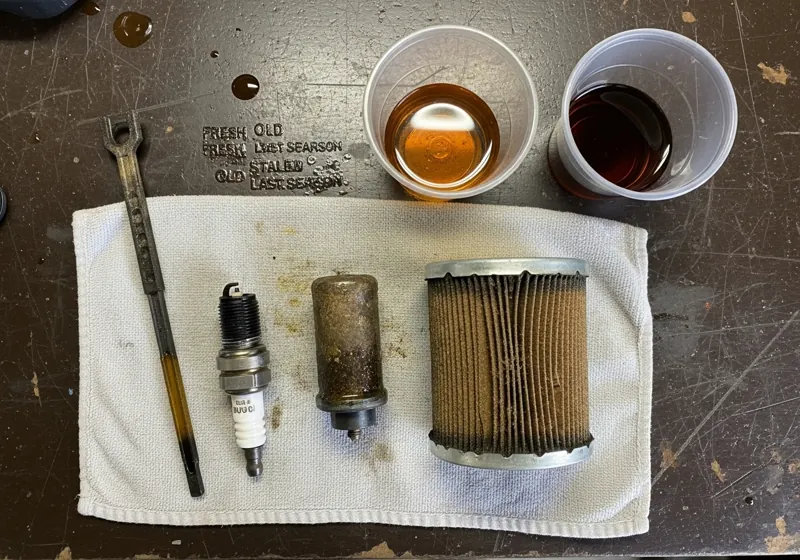
Here’s what nobody tells you when you buy a mower: they’re temperamental little machines that basically want three things to run. Spark, air, and fuel. That’s it. Sounds simple, right?
After fixing literally hundreds of these things (I started keeping a spreadsheet in 2019, because apparently that’s what I do for fun now), I can tell you the breakdown. Bad gas causes about 40% of starting problems. Just straight-up old, stale fuel sitting in there from last season. Air filter issues? Another 25%. Spark plug problems account for maybe 20%. The remaining 15% is everything else… safety switches, bad batteries on riding mowers, carburetor problems, or actual mechanical damage.
The thing is, most people start troubleshooting in the completely wrong order. They’ll drop $300 at the repair shop when the problem was literally a $6 spark plug. I know because I did exactly that in 2017 with my Craftsman. The mechanic even looked embarrassed when he showed me the fouled plug. “Yeah, uh, that’ll be $89 for the diagnostic fee and $40 for labor.” I wanted to die. If you want more diagnostic strategies beyond just starting problems, check out my complete troubleshooting guide that covers everything from engine issues to drive system failures.
So I developed what I call the SAFE method. No, I didn’t come up with a clever acronym and then work backward (okay, I totally did), but it actually works. SAFE stands for Spark, Air, Fuel, and Engine. Check them in that order, and you’ll find your problem nine times outta ten.
Real talk: if you skip straight to tearing apart the carburetor without checking the basics first, you’re gonna have a bad time. And probably extra screws left over when you put it back together. Ask me how I know.
Step-by-Step Troubleshooting: The SAFE Method
Alright, let’s get into the actual diagnosis. Grab a beer (or coffee, I’m not judging), find a shady spot in your garage or driveway, and let’s figure this out systematically instead of just randomly replacing parts like I did when I was younger and dumber.
S is for Spark
First thing, and I mean the very first thing you should check, is whether you’re getting spark to the combustion chamber. This is so simple it’s almost embarrassing, but I’ve seen people (including past me) completely skip this step.
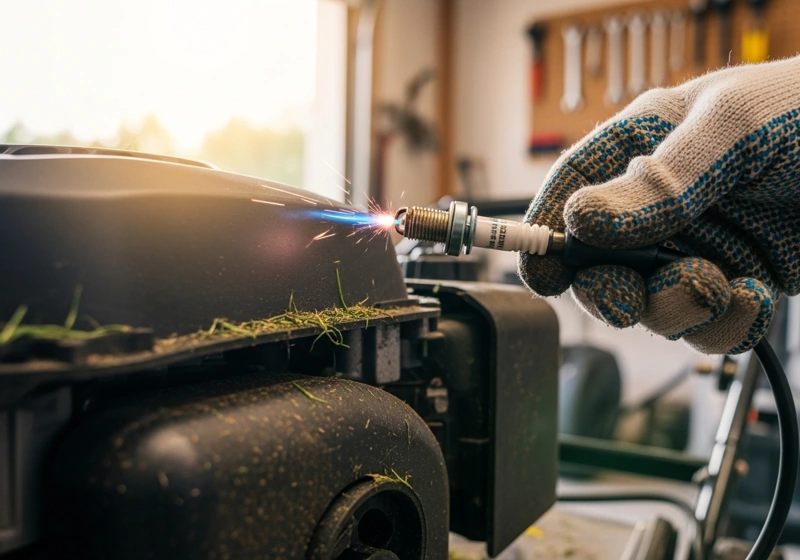
Pull the spark plug. Use a spark plug socket or a deep socket if you’re in a pinch, though you might scratch the porcelain if you’re not careful. Got it out? Good. Now reconnect the spark plug wire to the plug (while you’re still holding it… don’t drop it because you will, trust me). Ground the threaded part of the plug against the engine block or the metal shroud. Pull the starter cord and watch for a bright blue spark across the gap.
No spark? Replace the plug. They’re like $3.29 at any hardware store. Get the exact model your mower needs, though… the gap width matters more than you’d think. I once spent an entire afternoon troubleshooting a mower before realizing I’d installed a spark plug with the wrong gap. The old “measure twice, cut once” thing applies to spark plugs, too, apparently.
If you DO get spark and the mower still won’t start, move on. Don’t be like my buddy Mike, who replaced a perfectly good spark plug three times because he was convinced that it had to be the problem. Sometimes it’s just not the spark, Mike.
A is for Air
Your engine needs air to create combustion. Seems obvious when I say it like that, right? But you’d be shocked how many people run their mowers with completely clogged air filters.
Pop off the air filter cover… usually there’s just one screw or maybe a couple of clips. Pull out the filter. If it’s a paper filter and it’s darker than a weak cup of coffee, it’s done. Trash it. Don’t try to blow it out with compressed air to “save money.” I did that for years and wondered why my mower ran like garbage. A new filter is $8.47 at Home Depot. Just buy it. Not sure where to buy parts or whether to go OEM or aftermarket? Check out my complete parts buying guide before you head to the store.
Foam filters (the pre-cleaner type) can be washed in warm soapy water, squeezed out, and re-oiled with a tiny bit of motor oil. Emphasis on tiny. I absolutely drowned my first foam filter in oil like I was deep frying it. Mower smoked like a barbecue pit for twenty minutes. My partner thought I’d set something on fire. Not my finest moment.
Here’s something weird I discovered last summer: wasps. Sometimes wasps build nests in the air intake. Happened to my neighbor’s Toro. Toro lawn mower won t start, turns out there was a whole wasp apartment complex blocking the air intake. Sprayed it with wasp killer, waited an hour, cleaned it out. Boom. Started right up.
While we’re on the subject, check the breather tube too. It’s that little tube that vents your crankcase. If it’s clogged, your engine can’t breathe properly, and it’ll run like absolute garbage or not start at all. I found a mud dauber nest in mine once. Those things are everywhere, I swear.
F is for Fuel
Now we get to the big one. The most common culprit. The reason your lawn mower won’t start after winter storage.
Gas goes bad. Like, really bad. After about 30 days, the lighter hydrocarbons start evaporating and the gas starts turning into basically varnish. By 90 days? Forget it. That gas is completely useless. I learned this the hard way when I left gas in my push mower over the winter of 2018. Next spring, won’t start. Drained the tank, and what came out looked like weak iced tea. Smelled like paint thinner mixed with regret.
First step: drain the old gas completely. I use a turkey baster from the dollar store (DO NOT use your partner’s good one from the kitchen… major trust me on this one). Suck out all the gas you can from the tank, then tilt the mower to get the rest out. Have a container ready. I use an old milk jug. Don’t just dump it on your lawn unless you want a dead spot that’ll haunt you for months. Been there.
Next, you gotta drain the carburetor bowl. There’s usually a small drain screw or bolt on the bottom of the carb. Put a rag under it, loosen it, and let the old gas drain out. Sometimes what comes out is straight-up goo. Brownish, sticky goo that has no business being in a carburetor. If it’s really bad, you might need to spray some carb cleaner in there.
Oh, and another thing. Check your fuel line for cracks. I had a Craftsman push mower not starting situation last year, where the fuel line had a tiny split in it. Tiny. Smaller than a grain of rice. But it was sucking air instead of pulling fuel. Replaced the line for $4.12. Problem solved.
Fill up with fresh gas. I mean gas from the station within the last week, not that container in your garage from who-knows-when. And look, I know gas stabilizer seems like a scam, but it’s not. Add some Sta-Bil or similar additive if the mower’s gonna sit for more than a month. I fought this recommendation for years. I was wrong. The stuff works.
Wait, let me back up a second. Before you drain everything, make sure your fuel shutoff valve is actually open. Laughing yet? Don’t. I troubleshot a mower for 45 minutes once before realizing the valve was closed. My neighbor just watched me from his porch the whole time. Never said a word. Still brings it up at barbecues.
E is for Engine
If you’ve checked spark, air, and fuel and your mower STILL won’t start, now we’re getting into actual engine problems. This is where things get interesting (and potentially expensive).
Check your oil level. Seriously. A lot of modern mowers have a low-oil shutoff sensor. If your oil’s low, the mower literally won’t start. It’s a safety feature, which is great until you’re standing there like an idiot pulling the cord 50 times because you forgot oil exists.
Pull the dipstick. Wipe it clean. Put it back in (most mowers you don’t screw it in to check, you just rest it on the threads). Pull it back out. The oil should be between the min and max marks. If it’s low, add the correct oil for your mower. Most push mowers use 10W-30 or SAE 30. Check your manual. Or don’t, because nobody keeps their manuals, so just look at the oil cap… sometimes it’s printed right there. Want to understand more about how your mower’s engine actually works? I’ve got a deep dive into different engine types and how to maintain them.
While you’re checking oil, look at its color. Should be amber-ish, like honey or weak tea. If it’s black as midnight or smells burnt, you need to change it. If it smells like gas or looks thinner than it should, you might have gas leaking into your crankcase. That’s a bigger problem, probably needs a carburetor rebuild or replacement.
Another thing to check: make sure you didn’t hit something and bend the crankshaft. Sounds dramatic, but it happens. I ran over a decorative rock (that I absolutely did not see, for the record), and the mower just stopped dead. Wouldn’t restart. The blade was hitting the housing on every rotation because the shaft was slightly bent. That one DID require professional help. Cost me $180. The rock remains in my garage as a reminder of my shame.
Speaking of which… sometimes the blade bolt works itself loose. When that happens, the blade can slip on the crankshaft, and the engine will spin, but the blade won’t. Makes this weird free-spinning sound. Tighten that bolt. Should be snug but not Hulk-smash tight. I stripped one once, trying to make it “extra secure.” Had to use an easy-out to remove the bolt. Not fun.
Lawn Mower Won’t Start After Winter: Post-Storage Solutions
Every spring, my phone blows up with the same question. “Hey Amelia, my mower worked fine last fall, now it won’t start at all. What gives?”
Lawn mower won t start after winter storage is basically its own category of problem. And honestly? It’s almost always preventable. But we’re human, we forget, we get lazy, and then spring rolls around, and we’re dealing with the consequences.
Here’s what happened to mine after the winter of 2019-2020. I was in a rush that last month of October, so I skipped my usual winterization routine. Just parked it in the garage, figured I’d deal with it in spring. Big, big mistake. Come April, it wouldn’t start. At all. Not even a sputter.
The problem was the carburetor. The gas had turned to varnish (we already talked about this, but it bears repeating because it’s SO COMMON), and that varnish had completely gummed up the tiny jets inside the carb. The needle valve was stuck. The float was sticky. It was a mess. Had to pull the whole carburetor off, soak it in cleaner overnight, blow out all the passages with compressed air, and reassemble it. Took me three hours, and I had four screws left over. Which… probably isn’t great, but it’s been running fine for five years now, so whatever.
What you should do BEFORE winter: Run the mower until it’s out of gas, or add fuel stabilizer and run it for five minutes to get the treated gas through the system. I know, I know… It’s one more thing on the list. But trust me, spending ten minutes in October beats spending three hours in April.
If you forgot to do that (been there), here’s your spring revival plan.
Drain all the old gas. Every drop. Check the fuel filter if your mower has one (usually in the fuel line between the tank and carb)… if it’s brown or clogged, replace it. They’re about $5.83 at most hardware stores.
Remove and clean the spark plug. If it’s covered in black carbon deposits or the electrode is worn down, just replace it. While it’s out, squirt a tiny bit of oil into the cylinder. This is called “priming,” and it helps if things are dried out. Not too much, though. Like, three drops. I used half a can of WD-40 once, and the mower smoked for 20 minutes when it finally started. Smelled like a burnout contest.
Check your battery if you have a riding mower. Batteries hate cold weather. If you didn’t use a trickle charger over the winter (I never do, even though I should), your battery is probably dead or close to it. Jump it with your car battery or a jump pack. If it’s more than three years old and won’t hold a charge, it’s probably done. The new one runs $45-$90, depending on the size. Speaking of batteries, if you’re tired of dealing with gas and winter storage issues, battery-powered mowers might be worth considering.
One more thing about post-winter starting… sometimes condensation builds up inside the gas tank over winter. Water and gas don’t mix, and water in your fuel system is basically a death sentence for starting. If you suspect water contamination, you’ll need to drain everything completely and maybe even drop the fuel tank to clean it out. Or use a fuel system treatment specifically for water removal. I like HEET or similar products. Pour it in, add fresh gas, and cross your fingers.
The Carburetor Deep Clean
If draining old gas and replacing the spark plug doesn’t work, your carburetor probably needs a deep clean. This is where most people give up and call a pro, but honestly? It’s not that hard. Just tedious.
You’ll need: carb cleaner spray, a small wire or needle for cleaning jets, a bowl to catch old gas, and patience. Lots of patience. And maybe a beer, but not until AFTER you’re done because working with gasoline and alcohol (in your belly) is stupid.
Take photos as you disassemble. I’m serious. Use your phone and take a pic of every step. You will forget how it goes back together. Everyone does. I have approximately 87 photos of various carburetors on my phone, and my partner thinks I’ve lost my mind.
Remove the air filter and housing. Disconnect the fuel line (have a rag ready, gas will dribble out). Remove the two or three bolts holding the carburetor to the engine. Wiggle it off. You might need to disconnect the throttle linkage… take a photo of how that connects before you remove it.
Flip the carb over and remove the bowl. It’s usually held on by a single bolt in the center. The bowl will have old gas in it. Dump it in your container (not on the ground, we’re trying to be responsible adults here). Look inside… see that gooey varnish stuff? That’s your enemy.
Spray carb cleaner everywhere. And I mean everywhere. Into every hole, around every valve, through every passage you can see. Let it sit for a minute. Spray again. Use your wire or needle to poke through the tiny jets. They’re usually brass and about the size of a pinhead. Super easy to lose, so work over a white rag or towel.
The float needle and seat need special attention. That’s the valve that controls fuel flow into the bowl. If it’s stuck (which it probably is), gently work it loose with your fingers. Don’t force it, though. You can bend the float arm, and then you’re buying a whole new carb.
Reassemble in reverse order. Use your photos. Tighten bolts snug but not crazy tight. Carb bodies are usually aluminum or pot metal, and they strip easily. Learned that the hard way on a Craftsman riding lawn mower not starting back in 2020. Stripped the mounting hole, had to use a helicoil insert to fix it. Added an extra hour to the job.
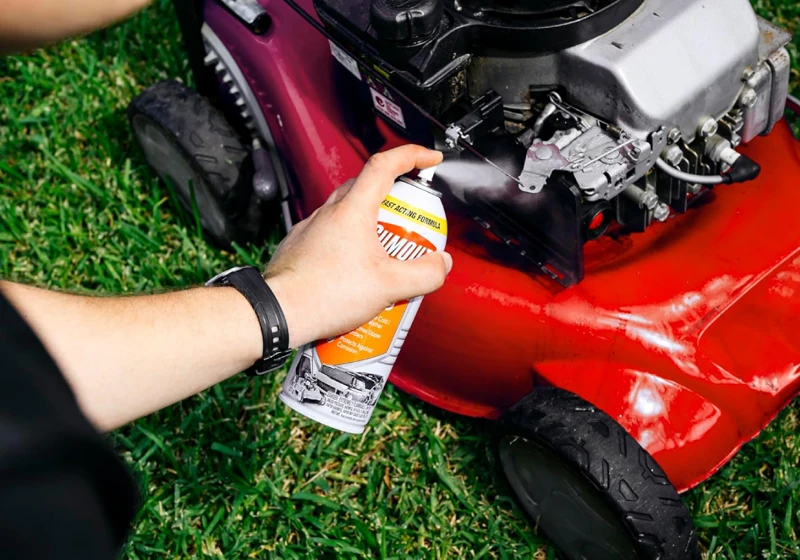
Push Mower Not Starting: Specific SolutionsThe
The Push mower will not start. Problems are a bit different than riding mower issues. Simpler in some ways, more finicky in others.
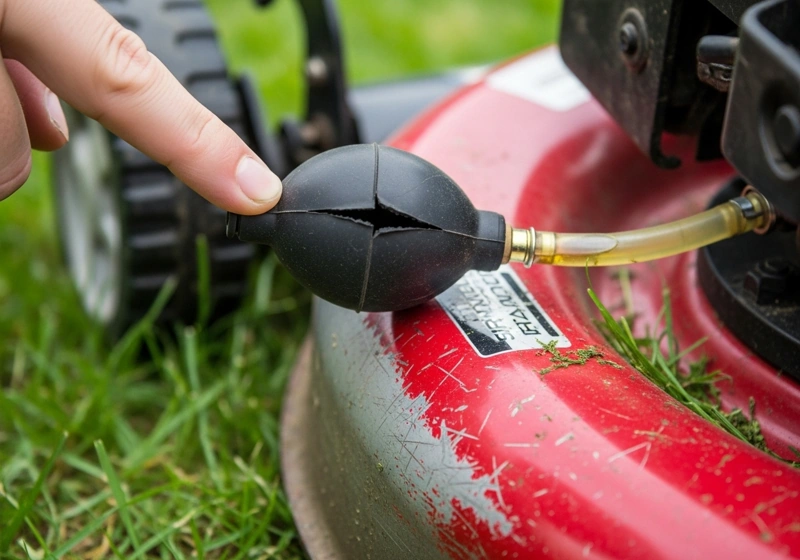
The primer bulb is your friend. That little rubber button you press before starting? It’s literally pumping a shot of fuel directly into the carb. If it’s cracked, split, or not sealing properly, you’re not getting that primer fuel. Press it… You should feel resistance and see gas moving through the clear fuel line (if you have one). If the bulb is hard as a rock or completely mushy, replace it. They’re like $3.74 at any hardware store.
I had a Honda push mower not starting last summer, which stumped me for way too long. Tried everything. Fresh gas, new spark plug, cleaned the air filter, nothing. Turns out the primer bulb had a tiny crack I couldn’t even see. Replaced it and boom, started on the first pull. Felt like an idiot, but hey, you live and learn.
The recoil starter can also be an issue. If you’re pulling the cord and it feels super easy with no resistance, the starter pawls might be stuck or broken. You’ll need to remove the recoil cover (usually 3-4 bolts) and inspect the mechanism. Sometimes they just need a shot of WD-40 to free them up. Other times, the springs are broken and you need a whole new assembly.
Check your blade too. This sounds weird, but stay with me. If your blade is super dull or damaged, it creates so much drag that the engine can’t turn over properly. I’ve seen this on older mowers where someone hit a stump or something and really messed up the blade. The engine tries to start, the blade resists, engine gives up. Sharpen or replace the blade, and suddenly it starts fine.
Another thing specific to push mowers: the engine brake cable. That’s the bar you hold down on the handle to keep the mower running. If that cable is broken or adjusted wrong, the engine brake stays engaged and prevents starting. There’s usually an adjustment nut where the cable connects to the engine. Loosen it a bit if the brake seems too tight. If you’re shopping for a new push mower that’s less finicky about starting, self-propelled models with modern fuel systems tend to be more reliable.
Oh, and here’s a fun one nobody tells you about. The flywheel key. It’s a tiny piece of soft metal that aligns the flywheel to the crankshaft. If you hit something hard enough to stop the engine suddenly, that key shears (it’s designed to, to protect the engine). When it shears, the timing is thrown off and the mower won’t start. You’ll need to pull the flywheel (requires a puller tool, about $18 on Amazon) and replace the key (about $2.50). Did this on my Toro lawn mower after I ran over a tree root in 2021. The impact was… significant. My dogs ran away. It was dramatic.
Riding Lawn Mower Will Not Start: Advanced Diagnostics
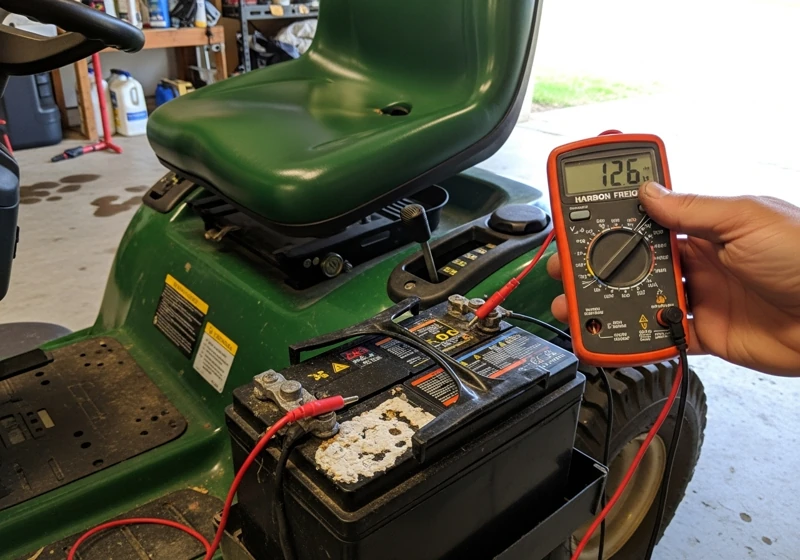
Okay, so your riding lawn mower will not start. These are more complex machines, which means more stuff that can go wrong. But also more ways to diagnose the problem. If you’re constantly dealing with starting problems on an older riding mower, it might be time to consider an upgrade.
First off: do you hear a click when you turn the key? That’s your starter solenoid trying to engage. If you hear clicking but no cranking, your battery is probably too weak to turn the starter. Jump it or charge it. If it still just clicks with a fully charged battery, your starter or solenoid is bad.
No click at all? Check your safety switches. Riding mowers have like 47 of them (okay, maybe 5 or 6, but it feels like 47). There’s one under the seat, one or two for the brake pedal, one for the PTO (power take-off, that’s your blade engagement), and sometimes one for the transmission if it’s not in neutral.
The seat safety switch fails ALL THE TIME. It’s this little pressure switch under your seat that makes sure someone is actually sitting on the mower when it runs. Makes sense for safety, but when they fail, they’re super annoying. You can bypass them temporarily for testing (just connect the two wires), but please, PLEASE reconnect them properly or replace them once you’ve confirmed that’s the problem. Safety switches exist for a reason. I’ve seen what happens when someone falls off a running mower. Not pretty.
Test them systematically. Sit on the seat. Press the brake pedal down. Make sure the PTO is disengaged (knob or lever pushed in/down). Make sure the transmission is in neutral or park. Turn the key. Still nothing? Start bypassing switches one at a time to isolate which one is bad.
Had a Craftsman riding lawn mower not starting situation with my father-in-law’s mower two years ago. Drove me absolutely crazy. Checked everything. The battery was good. The starter was good. All the obvious stuff. Turns out there was a loose wire connection on the neutral safety switch… the plug had vibrated loose over time. Pushed it back on and suddenly everything worked. Felt good to figure it out, but also mildly annoyed it was something so simple.
Battery and Electrical Issues
Your riding mower battery should read about 12.6 volts when fully charged. Below 12 volts, and it’s getting weak. Below 11.5 and it’s basically done. Get a cheap multimeter (like $12.47 at Harbor Freight) and check the voltage at the battery terminals.
Clean your battery terminals. Seriously, just clean them. Corrosion builds up (that white crusty stuff or greenish blue powder) and prevents good electrical contact. Wire brush them clean, or use a battery terminal cleaning tool. They’re like $6. Or pour some Coke on them… the acid in Coke dissolves the corrosion. Sounds weird, works great. My dad taught me that trick 20 years ago.
Check your charging system while you’re at it. Start the mower (jump it if needed) and measure voltage at the battery with the engine running. It should be around 13.5-14.5 volts. If it’s not, your alternator or voltage regulator is probably bad, and your battery isn’t being charged while you mow. You’ll be able to start it once it’s charged, but then it’ll be dead again next time.
The starter itself can fail, too. You can test it by bypassing the solenoid. Connect a jumper cable directly from the positive battery terminal to the small positive post on the starter (not the big cable, the smaller one). If the starter spins, your solenoid is bad. If it doesn’t spin, your starter is bad. Replace accordingly. Starters are usually $75-$15,0, depending on the model.
The Dreaded Fuel Pump
Unlike push mowers that rely on gravity to feed fuel, most riding mowers have a fuel pump. It’s usually a small plastic or metal box between the fuel tank and the carburetor. They fail. A lot. Replaced one on my John Deere last year. The thing was 8 years old, and finally gave up.
You can test it by disconnecting the fuel line going to the carb and cranking the engine. Fuel should pulse out of the line. If it doesn’t, your pump is dead. Some pumps are vacuum-operated (run off engine vacuum), others are electric. Electric ones, you can hear clicking when you turn the key. No click? Bad pump or bad pump relay.
Replaced one on my John Deere last year. The thing was 8 years old and finally gave up. Cost $37.89 for the pump plus about 30 minutes of my time. Not the worst repair I’ve done, but trying to keep old gas from spilling everywhere while I swapped it was… an adventure. Pro tip: Clamp the fuel lines before disconnecting stuff. There are cheap squeeze-off pliers made exactly for this. Use them.
Brand-Specific Starting Problems: Toro & Craftsman
Let’s talk about the two brands I see most often with starting issues: Toro and Craftsman.
Toro Lawn Mowers
Toro lawn mower won t start. Problems are usually carburetor-related. Toros are great mowers (I actually really like them), but their carburetors seem more sensitive to old gas than other brands. I think it’s because they run leaner for emissions reasons? Don’t quote me on that, but it’s my theory.
The Personal Pace self-propel system on Toro mowers can also cause starting issues. If the drive system is engaged when you try to start, it creates extra drag. Make sure the self-propel bar is fully released before pulling the cord. Sounds obvious, but I’ve seen it happen.
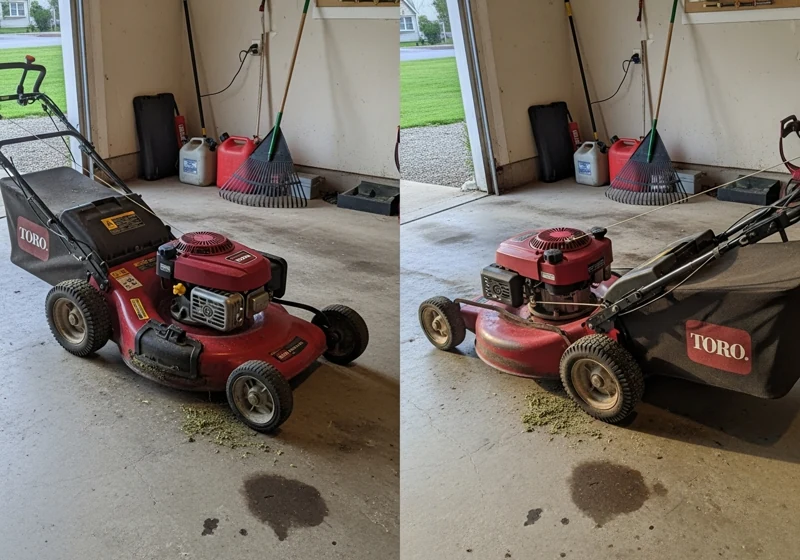
Toro also uses this weird little plastic primer bulb that seems to crack if you look at it wrong. Seriously, I’ve replaced so many of these things. Check it carefully for cracks. Even a tiny hairline crack means it’s not creating proper pressure.
One specific issue with older Toro Recycler models (like the 2010-2015 era): the blade brake cable adjustment. They set them too tight from the factory, and after a few years, the cable stretches. When that happens, the brake doesn’t fully release, and the engine can’t turn over easily. There’s an adjustment barrel near the engine… give it a few turns to loosen the cable tension. Fixed one exactly like this for my neighbor last month. Took literally 2 minutes.
Craftsman Lawn Mowers
Craftsman push mower not starting and Craftsman riding lawn mower not starting issues are… well, they’re common. Craftsman mowers are fine (they’re made by MTD and use various engines), but they seem to have more electrical gremlins than other brands.
The kill switch wire on Craftsman push mowers is famous for failing. It’s the wire that connects to the flywheel brake and stops the engine when you release the handle. If that wire breaks or shorts out, the mower thinks you want it stopped, even when you’re trying to start it. Disconnect the wire from the engine (it’s usually a little connector near the spark plug) and try starting. If it starts with the wire disconnected, that’s your problem. You can run without it temporarily, but you have to remember to disconnect the spark plug to stop the mower instead of just releasing the handle.
On Craftsman riders, the seat safety switch fails constantly. Like, it’s almost guaranteed to fail within 5-7 years. The little plastic plunger breaks, or the internal switch contacts corrode. Replace it. They’re $15-$2,5 depending on your model. Or if you’re feeling cheap (and understand the safety implications), you can bypass it. I don’t recommend that, but… I’ve done it on my own mower, so who am I to judge?
Craftsman riding mowers from the early 2000s also have this annoying issue where the solenoid gets corroded and doesn’t make good contact. You can sometimes whack it with a wrench handle while someone turns the key, and it’ll start. That’s how my dad kept running for like 3 years. Eventually, you gotta replace it though.
Here’s a weird Craftsman-specific thing I discovered: some models have a reverse safety switch that prevents you from engaging the blades while in reverse. Makes sense. But sometimes that switch fails in a way that prevents starting entirely. It’s usually a little plunger switch under the transmission shifter. Wiggle the shifter while trying to start. If that helps, you found your problem.
When to DIY vs Call a Professional
Look, I love DIY. I fix almost everything myself. But sometimes… sometimes you just gotta call someone who knows what they’re doing.
You can definitely DIY:
- Spark plug replacement (5 minutes, $3-$6)
- Air filter replacement (3 minutes, $8-$15)
- Oil changes (15 minutes, $10-$20 in oil)
- Blade sharpening/replacement (20 minutes, $12-$35)
- Carburetor cleaning (1-2 hours, $8 in cleaner)
- Battery replacement (10 minutes, $45-$90)
- Fuel line replacement (15 minutes, $4-$8)
- Basic safety switch replacement (20 minutes, $15-$25)
Total cost savings by doing these yourself instead of hiring someone? Probably $200-$400 per year, depending on how often stuff breaks. The diagnostic fee alone at most shops is $75-$100, and that’s before they even fix anything.
You should probably call a pro for:
- Valve adjustments (requires feeler gauges and knowledge)
- Carburetor rebuilds beyond basic cleaning (lots of tiny parts)
- Transmission repairs (complicated and expensive to screw up)
- Engine rebuilds or major internal work (requires special tools)
- Hydrostatic system repairs (messy and technical)
- Ignition coil/flywheel magnet replacement (requires torque specs)
For complex repairs like transmission work, check out my comprehensive maintenance guide to understand what you’re getting into.
I tried to adjust the valves on my Briggs & Stratton engine once. Once. The engine ran like absolute garbage afterward because I got the clearances wrong. Took it to a shop, cost me $120 to have them fix my “fix.” Lesson learned. Some things are worth paying for.
The Cost Reality Check
A typical shop will charge $75-$100 just to look at your mower. Then $50-$85 per hour for labor. Parts are marked up 30-50% over what you’d pay retail. A simple “won’t start” diagnostic and repair often runs $150-$250, depending on what’s wrong.
Compare that to buying a $12 multimeter, $8 can of carb cleaner, and a $4 spark plug. Even if you spend two hours fumbling around learning, you’re still way ahead financially. Plus, you learn something. And honestly? There’s something satisfying about fixing your own stuff.
But if you’re looking at a $400 repair quote for a mower that’s only worth $300? That’s when you start browsing Facebook Marketplace for a replacement. Been there. Did that. No regrets.
Tool Investment
You don’t need much to troubleshoot and fix most mower won’t start problems:
- Basic socket set ($25 at Harbor Freight)
- Screwdriver set ($12)
- Spark plug socket ($4)
- Multimeter ($12-$15)
- Funnel and container for draining gas ($6 combined)
- Carburetor cleaner ($6-$8)
For about $70-$80 total, you’re set up to fix probably 90% of starting problems. Those tools will last for years and work on other small engines too (snowblowers, generators, string trimmers, etc.). Return on investment is like the second time you use them. These same troubleshooting principles apply to most small engines, and my seasonal guide covers maintaining all your outdoor power equipment year-round.
I’ve had the same basic tool kit since 2016. It lives in a plastic toolbox under my workbench and has probably saved me $2,000+ in shop fees over the years. Plus, I can fix my friends’ mowers and feel like a hero at cookouts. “Oh, your mower won’t start? Bring it over, I’ll take a look.” That’s my thing now, apparently. And hey, if you’re researching mowers and trying to decide between brands before making a purchase, I’ve compared all the major manufacturers to help you choose one that’s actually reliable.
So that’s basically everything I’ve learned from 20+ years of dealing with mowers that refuse to cooperate. Most starting problems really are simple… It’s just knowing what to check and in what order. The SAFE method has never failed me. Well, rarely. There was this one Snapper that I swear was possessed, but that’s a story for another time.
If I had to leave you with one piece of advice, it’s this: Don’t panic when your mower won’t start. Take a breath, work through the checklist, and you’ll find the problem. And if you can’t? Hey, that’s what pros are for. No shame in knowing your limits.
Now go fix that mower. Your grass isn’t getting any shorter while you’re reading this.
Fresh gas fixes most starting problems, but not all of them. If you’ve got fresh fuel and it still won’t start, work through the SAFE method I mentioned earlier. Most likely, it’s a spark plug issue (fouled or wrong gap), a clogged air filter restricting airflow, or old gas still sitting in the carburetor bowl even though you added fresh gas to the tank. It could also be a compression problem if you have low oil or internal engine damage. I had this exact situation last spring. Put in fresh gas, still wouldn’t start. Pulled the spark plug, and it was black as coal, completely fouled. New plug, started immediately. Sometimes it really is that simple. Or… and this is embarrassing, but I’m sharing it anyway… make sure the choke is actually in the correct position. I spent 20 minutes troubleshooting a mower once before realizing I had the choke in the wrong position. It was a new-to-me mower, and the choke worked opposite of what I expected. My partner watched the whole thing from the porch. Still hasn’t let me forget it.
This is basically what we covered in the winter storage section, but here’s the quick version: Drain ALL the old gas from both the tank and the carburetor bowl. I mean all of it. That gas has turned to varnish. Replace the spark plug (it’s $3, just do it). Check and clean or replace the air filter. Add fresh gas with some fuel stabilizer mixed in. Pull the cord. If it still doesn’t start, you probably need to clean or rebuild the carburetor because the jets are clogged with varnish. The lawn mower doesn t start after winter fix has cost me anywhere from $3 (just a spark plug) to about $35 (full carb rebuild kit plus my time). Usually closer to the cheaper end if you catch it early.
Spark plug. Always start with the spark plug. It’s the easiest, cheapest, and most common cause of starting problems. Pull it out, check for fouling (black deposits), check the gap with a gap tool (should be 0.030″ for most mowers, but check your manual), and test for spark by grounding it against the engine while pulling the cord. If the plug looks good and sparks properly, check the air filter next. Takes 30 seconds to pop off the cover and look. Then check your gas. When was it added? More than 30 days ago? It’s probably bad. Drain it and add fresh. Those three things (spark, air, fuel) solve probably 85% of push mower will not start problems. The other 15% gets into more involved diagnostics, but starts with the easy stuff. Don’t be like me in my younger days, tearing apart the carburetor before checking if there was even spark. Work smart, not hard.
That clicking is your starter solenoid trying to engage but failing. Usually means one of two things: 1) Your battery doesn’t have enough juice to turn the starter. The solenoid needs like 1 amp to click, but the starter needs 100+ amps to actually turn the engine. The battery has enough power for the click but not the crank. Solution: charge or jump the battery. If it’s old (3+ years), probably time for a replacement. 2) Your starter or solenoid is bad. The solenoid clicks but isn’t actually making good contact to send power to the starter, or the starter itself is seized/damaged. You can test this by bypassing the solenoid with a jumper cable directly to the starter. If it spins, the solenoid is bad. If it doesn’t, the starter is bad. I’ve probably replaced a dozen riding mower solenoids over the years. They’re like $15-$30 and take maybe 15 minutes to swap. Just disconnect the battery first (trust me on this) because you’re working with some pretty heavy current.
Depends on your comfort level with basic tools and mechanical stuff. Most starting problems are super simple and definitely DIYable. We’re talking spark plugs, air filters, draining old gas, and cleaning a carburetor. If you can change a light bulb and operate a screwdriver, you can probably fix 80% of starting issues. But if you get into it and discover you need to adjust valves, rebuild the engine, or diagnose complex electrical problems, that’s when it makes sense to call someone. Or if you just don’t enjoy this kind of thing and would rather pay someone, that’s totally valid too. Your time has value. I always say try the easy stuff first. Worst case, you spend $20 on a spark plug and carb cleaner, it doesn’t work, and you call a pro anyway. You’re only out $20 and 30 minutes. Best case, you fix it yourself, save $150, and feel like a mechanical genius for the rest of the day. The riding lawn mower will not start. Problems are a bit more complex than push mowers, but even those are mostly DIYable if you’re patient and systematic about troubleshooting.
