
Lawn Mower Smoking: White, Blue & Black Smoke Causes
So your lawn mower smoking just turned your Saturday morning into a minor heart attack. Join the club.
Table of Contents
▼- Why Is My Lawn Mower Smoking? Understanding the Basics
- Lawn Mower White Smoke: Causes & Quick Fixes
- The Overfill (AKA “More Oil is Better, Right?”)
- Mowing Hills (Your Mower’s Not a Jeep)
- Water in the Fuel (The Winter Storage Special)
- The Head Gasket (The One We Don’t Want)
- Blue Smoke From Lawn Mower: Oil Burning Problems
- The Usual Suspects
- Can You Fix Blue Smoke?
- Lawn Mower Black Smoke: Fuel System Issues Explained
- Why This Happens (Spoiler: It’s Usually Your Fault)
- The Fix That Works 95% of the Time
- Lawn Mower Spitting Oil and White Smoke: Emergency Guide
- What’s Actually Happening
- The Overfill Disaster
- The Tip-Over Special
- When It’s Actually Serious
- Riding Mower Smoking When Blades Engaged: Special Cases
- It’s Not Always the Engine
- The Load Problem
- Deck-Related Issues
- The PTO Clutch Problem
- Electric Lawn Mower Smoking: Motor Overheating Solutions
- Why Electric Motors Smoke
- The Capacitor Failure
- When Electric Mowers Die
- Brand-Specific Smoking Issues: Toro, Honda, Craftsman & More
- Honda – The Oil Snobs
- Toro – The Breather Issue
- Craftsman – The Wild Card
- John Deere (Residential)
- Troy-Bilt
- When to Repair vs Replace a Smoking Lawn Mower
- The Real Math
- Age Matters (Like Everything Else)
- The Hidden Costs
- When to Absolutely Replace
- The Secret Shopping Season
- The Bottom Line
I still remember the first time I saw white smoke pouring out of my dad’s Craftsman – I was 14, home alone, and absolutely convinced I’d just destroyed the one thing he told me not to touch and spent three hours trying to “fix” it before he got home. Turns out? I’d tilted it wrong while cleaning the deck, and oil leaked where it shouldn’t. Five minutes of running and the smoke cleared right up.
It would’ve been nice to know that BEFORE the panic attack, right?
Look, after running my lawn care business here in Columbus for… geez, 15 years now? I’ve seen every type of smoking lawnmower situation you can imagine. The good news—and there IS good news—is that smoke color tells you exactly what’s wrong. It’s like your mower’s giving you a diagnosis; you just need to know how to read it.
White smoke means one thing. Blue smoke, totally different issue. Black smoke? That’s its own animal. Once you know what you’re looking at, most of these problems are Sunday afternoon fixes with basic tools. No mechanic required. (Though my wife would argue I say that about everything…)
Why Is My Lawn Mower Smoking? Understanding the Basics
Alright, before we dive into the specifics, let’s talk about what’s actually happening when you see lawn mower engine smoking. Because understanding the “why” makes the “how to fix it” part way easier.
Your mower’s basically a tiny controlled explosion machine. Gas and air mix, spark plug ignites it, boom – power. Most mowers use four-stroke engines, which are more complex than the old two-stroke but produce less smoke. When everything’s working right, the only thing coming out of your exhaust is invisible gases and a bit of heat. But when something’s off? That’s when you get the smoke show.
Here’s what each color actually means:
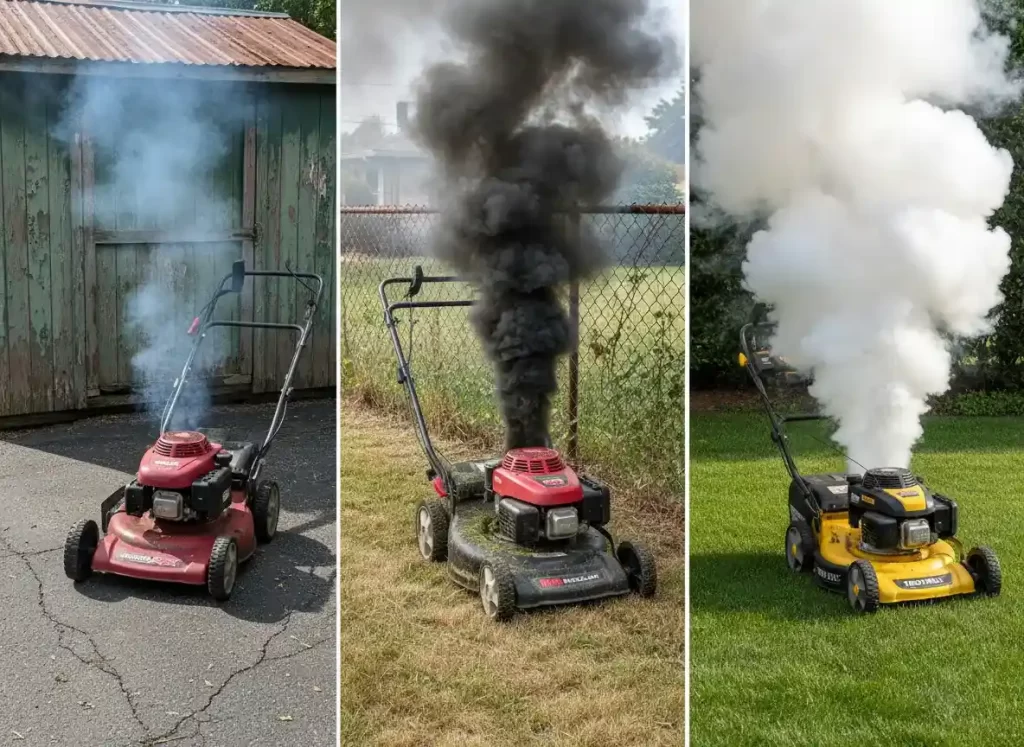
White smoke? You’ve got liquid where it shouldn’t be – either water from condensation or (more likely) oil that’s gotten into places it doesn’t belong. Usually happens when you overfill the oil. Ask me how I know. Actually, don’t – it’s embarrassing.
Blue smoke is oil actually burning in the combustion chamber. This one’s trickier because it means oil’s getting past seals or rings that are supposed to keep it out. Sometimes it’s age, sometimes it’s wear, sometimes it’s because you used the wrong oil type. Yeah, that matters more than you’d think.
Black smoke means you’re burning too much gas – what we call running “rich.” Your mower’s basically drowning in its own fuel. Wasteful? Yes. Dangerous? Not really. Annoying? Absolutely.
The thing is, people see smoke and immediately think “expensive repair” or “time for a new mower.” Nine times out of ten, that’s just not true. I’ve talked customers out of buying new $500 mowers when all they needed was a $7 air filter. That’s not great for my parts sales, but it’s the right thing to do.
Lawn Mower White Smoke: Causes & Quick Fixes
Let’s start with lawn mower white smoke since it’s what I see most often. Spring especially – my phone starts ringing in April with people convinced their mowers died over the winter. (Speaking of spring, our spring lawn care checklist helps prevent these issues.)
Lawn mower blowing white smoke usually comes down to four main culprits. And I’m gonna list them in order of how likely they are, not alphabetically or whatever. Because when you’re standing there with a smoking mower, you want to check the probable stuff first.
The Overfill (AKA “More Oil is Better, Right?”)
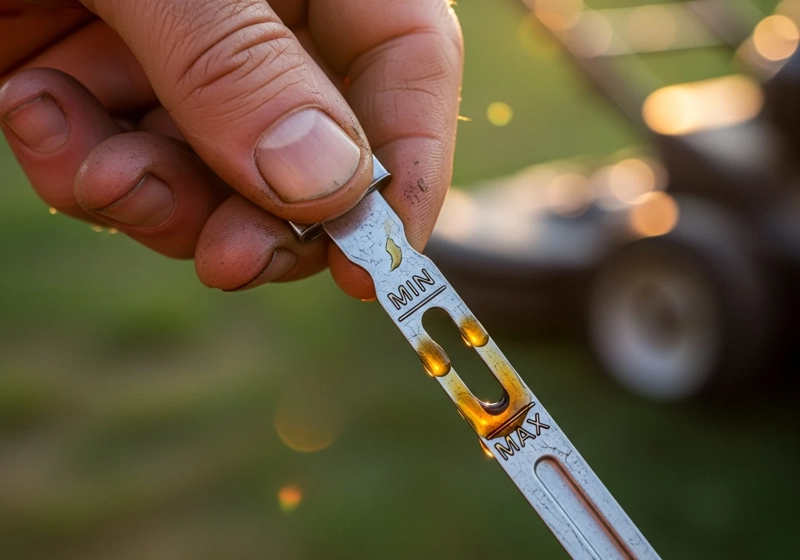
This is THE most common cause. You check the oil, looks a little low, add some more. Check again, still looks low, add more. Next thing you know, you’re running a quart and a half in a motor that holds three-quarters of a quart.
Here’s the thing – checking oil wrong causes more problems than not checking it at all. The mower needs to be level. Not kinda level. Level level. And the oil needs to settle for a minute after you’ve run it.
I had a customer last month who kept adding oil because he was checking it on his sloped driveway. Added nearly two quarts to a one-quart system. When he started it up… well, let’s just say his neighbors thought his garage was on fire.
Fix is simple: Drain oil til it’s between the lines on the dipstick. Not AT the max line – between the lines. There’s a buffer zone for a reason.
Mowing Hills (Your Mower’s Not a Jeep)
Mowers are designed to handle about a 15-degree slope. That’s it. Any steeper and oil starts going places it shouldn’t. Into the air filter, into the combustion chamber, basically everywhere except where it’s supposed to be.
You mow a steep hill, oil migrates, and suddenly you’re producing white smoke from lawn mower when starting the next time. The oil burns off eventually, but it looks scary as hell while it’s happening.
Quick fix? After mowing hills, let your mower sit on flat ground for 20-30 minutes before storing it. If you’re already seeing white smoke, just run it on flat ground for 10 minutes. Should clear up. If not, check your air filter – probably soaked in oil.
Water in the Fuel (The Winter Storage Special)
Condensation is a sneaky bastard. Your mower sits all winter, the temperature goes up and down, and water droplets form inside your gas tank. Come spring, that water gets sucked into the engine and… white smoke city.
You can actually test for this. Drain a bit of gas into a clear container. Water sinks to the bottom – if you see a separate layer, there’s your problem.
Lawn mower white smoke fix for water: Drain all the old gas (it’s probably crap anyway after sitting), add fresh fuel with some Seafoam or Stabil. About a capful per gallon. Run it for 15 minutes. Problem solved.
The Head Gasket (The One We Don’t Want)
If you’ve done everything above and you’re still getting consistent white smoke, especially with a loss of power… yeah, might be the head gasket. Check your oil – if it looks like a milkshake, that’s coolant mixing with oil. Bad news.
This is where you need to do some math. Head gasket repair runs $75-150 if you do it yourself, $200-300 at a shop. On a $400 mower that’s 8 years old? It might be new mower time. On a $1,200 riding mower that’s 3 years old? Fix it.
Blue Smoke From Lawn Mower: Oil Burning Problems
Blue smoke from lawn mower problems hurt my soul a little because they usually mean wear and tear you can’t just quickly fix. When you see lawn mower blue smoke, oil’s getting into the combustion chamber and actually burning. Not just vaporizing like with white smoke – burning.
The Usual Suspects
Worn piston rings are the big ones. These little metal rings keep oil in the crankcase and out of the combustion chamber. After… oh, 300-400 hours of use? They start wearing out. For most homeowners, that’s about 7-10 years. For my commercial guys, that’s one season.
You know it’s ringing when the smoke gets worse as the engine heats up. Cold engine, minimal smoke. Twenty minutes into mowing? Looks like you’re fumigating for mosquitoes.
Valve seal failure is another joy. These rubber seals sit on top of your valves, keeping oil from dripping down into the cylinder. When they go bad, you get that characteristic puff of blue smoke at startup that clears after a minute. Every. Single. Time. It’s like your mower picked up a morning cigarette habit.
Wrong oil type – and I see this constantly. Your mower calls for straight SAE 30, and you put in 10W-30 because “oil is oil,” right? Wrong. Multi-grade oils get thinner when hot. Check our complete engine oil guide to understand which oil your mower actually needs. In an air-cooled mower engine running at 180+ degrees, that 10W-30 turns into water and sneaks past every seal it can find.
Had a guy argue with me about this last week. “Been using 10W-30 for years!” Yeah, and you’ve been buying a new mower every three year, too, haven’t you?
Can You Fix Blue Smoke?
Depends on your skill level and patience. And wallet.
Piston rings? That’s a full engine rebuild. We’re talking pulling the head, removing the piston, installing new rings… It’s a whole thing. If you’re comfortable with advanced repairs, our small engine repair guide covers the process in detail. Parts are maybe $50. Labor at a shop? $300+. On most push mowers, that math doesn’t work.
Valve seals are slightly easier but still require head removal. If you’re handy and have a Saturday to kill, maybe. But honestly? Most people shouldn’t attempt this.
Best bet with blue smoke: live with it if it’s minor (just keep oil topped off), or start shopping for deals on new mowers. September through November, dealers are practically giving them away to clear inventory.
Lawn Mower Black Smoke: Fuel System Issues Explained
Lawn mower black smoke is actually my favorite problem to see. Not because I enjoy it, but because it’s almost always a cheap, easy fix that makes me look like a hero.
Black smoke means your mower’s running rich – too much gas, not enough air. It’s like trying to drink a milkshake through a coffee stirrer. The EPA estimates lawn mowers contribute significantly to air pollution, and running rich makes it worse. The engine’s working way too hard and can’t burn all the fuel it’s getting.
Why This Happens (Spoiler: It’s Usually Your Fault)
Sorry, but it’s true. Black smoke is almost always maintenance-related.
Dirty air filter. I cannot stress this enough. Your $7 air filter causes 90% of black smoke issues. NINETY PERCENT. That’s not an exaggeration – I’ve been tracking this for years because nobody believes me.
Your air filter is literally a piece of paper or foam keeping dirt out of your engine. After a season of mowing, it’s clogged with dust, grass particles, and whatever else. The engine can’t breathe, compensates by dumping more fuel, and black smoke everywhere.
Last month, a customer brought in a mower “needing carburetor work.” I pulled out his air filter – I swear you could’ve planted seeds in that thing. New filter, problem solved. He was amazed. I was $7 richer.
Choke stuck on. The choke enriches the mixture for cold starts. If it stays on after the engine warms up, you’re forcing it to run rich constantly. Sometimes the linkage sticks, and the automatic choke thermostat fails. Either way, black smoke.
Old gas. Fuel starts going bad after 30 days. After 3 months? It’s varnish. That partially clogs your jets, screws up the fuel mixture, and… you guessed it. Black smoke.
I had a customer insist his gas was “only from last fall.” Brother, it’s May. That gas is seven months old. It’s not gas anymore, it’s lawn mower poison.
The Fix That Works 95% of the Time
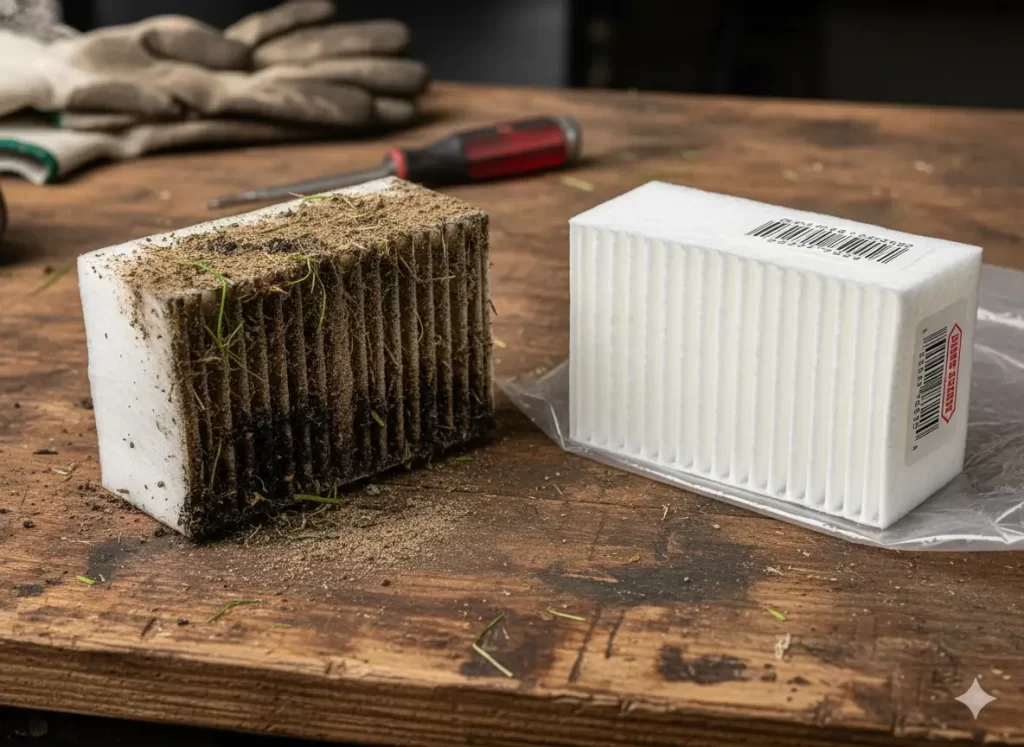
- Replace the air filter. Just do it. Don’t clean it, don’t blow it out with compressed air. Replace it. Seven dollars.
- Drain the old gas. All of it. Don’t just top it off with fresh gas – drain it completely.
- Add fresh fuel with stabilizer. I like Seafoam, but Stabil works too.
- Check that the choke opens fully when warm. You can see the butterfly valve in the carburetor throat – it should be straight up and down when running.
Still smoking? Then maybe it’s carburetor time. But try the simple stuff first. If you need to dive deeper, our carburetor cleaning and repair guide walks you through the entire process.
Lawn Mower Spitting Oil and White Smoke: Emergency Guide
Okay, this is the one that requires immediate action. Lawn mower spitting out oil and white smoke isn’t just a problem – it’s your mower having a legitimate crisis.
STOP THE ENGINE. NOW.
I’m not being dramatic. I’ve watched engines destroy themselves in under sixty seconds when this happens. (If your mower won’t restart after this, check our complete troubleshooting guide for next steps.)
What’s Actually Happening
When oil and smoke are coming out together, you’ve got massive internal pressure. Either you way overfilled the oil (like, seriously overfilled), or something’s blocking the crankcase ventilation, or you’ve blown a seal.
Picture shaking a soda bottle then opening it. That’s what’s happening inside your engine. Oil’s getting pushed out anywhere it can escape.
The Overfill Disaster
True story: Customer’s son “helped” by adding oil. The kid didn’t know you were supposed to drain the old oil first. Added a full quart on top of what was already there.
First pull of the cord? Oil shot out of every gasket, seal, and opening that motor had. Looked like the Exxon Valdez in his garage. Took me two hours to clean that engine enough to even diagnose it.
If you just changed oil and this happens, you either:
- Massively overfilled it
- Didn’t tighten the drain plug
- Forgot to put the drain plug back (yes, this happens)
- Double-gasketed the oil filter (two gaskets = no seal)
The Tip-Over Special
Mower got tipped the wrong way for cleaning or storage? Oil migrates into the cylinder. Next start? Oil volcano.
Fix: Remove spark plug, pull the cord 10-15 times to clear the cylinder (wear safety glasses – oil will spray), reinstall plug. Messy but not fatal.
When It’s Actually Serious
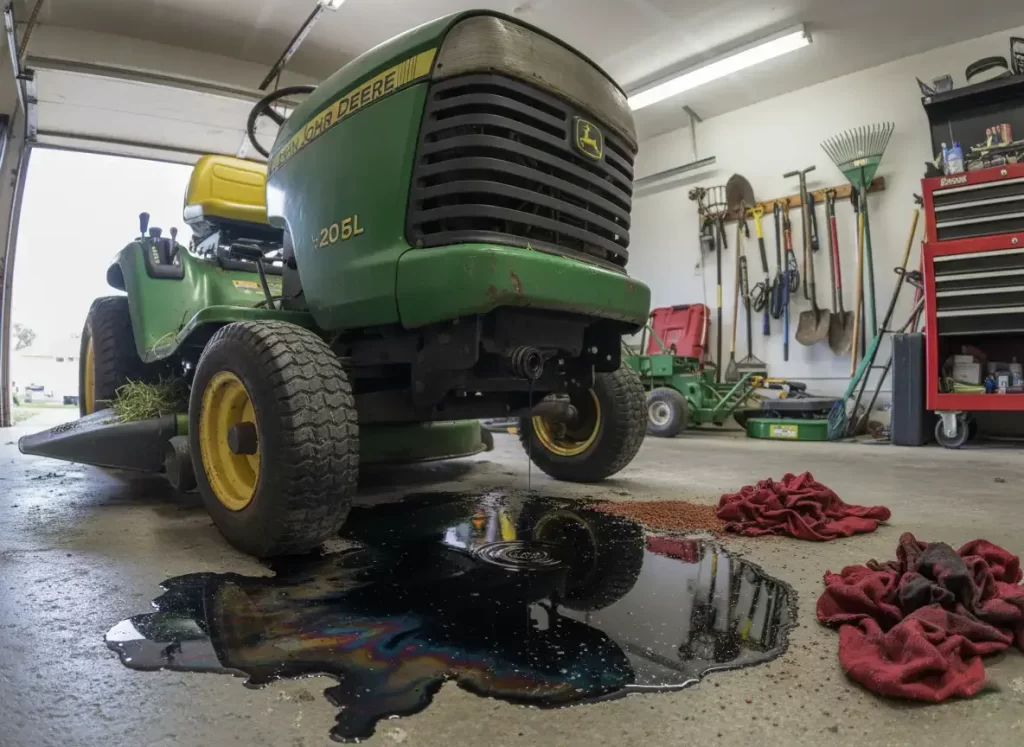
If the oil level was correct and you didn’t tip it, you’ve probably blown a crankcase seal or gasket. This happens when:
- The breather’s clogged (pressure builds up)
- The Reed valve fails
- The head gasket blows catastrophically
These are all “stop and assess” situations. Continuing to run makes it worse and more expensive.
Riding Mower Smoking When Blades Engaged: Special Cases
Riding mower smoking when you hit the blade engagement – this one’s interesting because the timing tells us everything. Your engine runs fine until you ask it to actually do work, then it protests with smoke.
It’s Not Always the Engine
Here’s something most people don’t realize: when your riding mower smokes when blades engaged, it might not be engine smoke at all.
Belt smoke smells like burning rubber (because it is). Happens when:
- Belt’s slipping on the pulleys (see our belt replacement guide if yours needs changing)
- Pulleys are misaligned
- Belt’s the wrong size (yes, there ARE different sizes)
- The idler pulley bearing is seized
I had a customer convinced his engine was blown. Nope – $25 belt was slipping. The smoke was rubber, not oil. Though I’ll admit, when you’re sitting on the mower, it all looks the same.
The Load Problem
Engaging blades increases engine load by about 30%. If your engine’s borderline on something – slightly too much oil, rings starting to wear, air filter partially clogged – that extra load pushes it over the edge.
Think about it like this: You might be able to walk up stairs fine, but carrying a heavy box makes you wheeze. Same concept.
Deck-Related Issues
You wouldn’t believe the crap I’ve pulled out from under mower decks. Grass clippings compressed into concrete. Actual concrete (don’t ask). A tennis ball wrapped in wire (still puzzling over that one).
When your deck’s clogged or blades are dull, the engine works harder. Learn how to sharpen your mower blade properly – sharp blades reduce engine strain and smoke issues. Working harder means more heat, more oil consumption, more everything. Hence, smoke when you engage.
Spent three hours last season cleaning under a customer’s deck. Three HOURS. The grass was so compacted that I needed a chisel. His “engine problem” disappeared with the grass boulders.
The PTO Clutch Problem
The PTO (Power Take Off) clutch engages your blades. When its bearing starts failing, it creates drag. The engine compensates by dumping more fuel. Black smoke city.
You’ll also hear it – grinding, squealing, general unhappiness. These run $150-300, depending on the model. Not cheap, but cheaper than a new rider.
Electric Lawn Mower Smoking: Motor Overheating Solutions
Electric lawn mower smoking is the one that genuinely makes me nervous. Unlike the benefits of electric mowers you usually hear about, smoke is never one of them. There’s no “normal” smoke from an electric motor. If you see smoke, something’s properly wrong.
UNPLUG IT FIRST. I don’t care if it’s still running fine. Unplug it. The CPSC warns about electrical hazards with powered equipment – always disconnect before inspection.
Why Electric Motors Smoke
Electric motors are simple – they spin when power’s applied. If they can’t spin freely, they convert that electrical energy into heat instead. Enough heat, and things start melting.
Grass wrapped around the blade shaft is numero uno. That grass creates resistance, the motor works harder, gets hotter, and eventually something melts or burns. Usually, the windings are inside the motor itself.
Saw one last year where the owner kept mowing despite the smoke because “it was still cutting.” Yeah, it was also melting its internal wiring. That $150 mower became a paperweight.
Blocked cooling vents are huge, too. Electric motors need airflow. Those vents clogged with grass clippings? Your motor’s basically wearing a winter coat in July.
Using it wrong – and people get mad when I say this, but it’s true. Electric mowers aren’t designed for 8-inch-tall wet grass. They’re for maintained lawns, regular cutting. You try to bush hog with an electric mower, you’re gonna have a bad time.
The Capacitor Failure
Capacitors help motors start. When they fail, they smell like dead fish. Not kidding. If your electric mower smells like low tide, that’s probably your capacitor going bad.
Good news? Capacitors are usually $15-30 and plug right in. Bad news? If the capacitor failed because the motor’s dying, you’re just postponing the inevitable.
When Electric Mowers Die
Here’s the brutal truth about electric mowers: when the motor goes, the mower’s done. A replacement motor costs more than a new mower 90% of the time.
Had a customer wanting to repair a five-year-old electric mower. Motor was $180. New mower with a warranty? $200. That’s not a hard decision.
Brand-Specific Smoking Issues: Toro, Honda, Craftsman & More
After working on literally hundreds of different mowers, you start noticing patterns. Toro lawn mower smoking tends to be different from Honda lawn mower smoking, which is different from Craftsman lawn mower smoking. Let me share what I’ve learned the hard way.
Honda – The Oil Snobs
Honda engines are bulletproof IF you treat them right. But man, they’re particular about oil. If you’re debating between brands, our Honda vs Toro comparison breaks down the differences. Honda lawn mower smoking often comes down to using the wrong oil grade.
Honda says to use straight SAE 30? They mean it. Not 10W-30, not 5W-30, not “close enough.” SAE 30. Their engines have tighter tolerances than most, and multi-grade oil causes problems.
Also, their auto-choke system? Tends to stick around year 5. Makes them run rich, black smoke everywhere. The thermostatic valve is like $25, takes ten minutes to swap. But nobody knows this, so they junk perfectly good mowers.
Toro – The Breather Issue
Toro lawn mower smoking (on models with Briggs engines) usually traces back to the breather assembly. It’s this little valve that lets crankcase pressure escape. When it clogs – and it WILL clog – pressure builds up and forces oil places it shouldn’t go.
I service every Toro that comes in, whether it needs it or not. Five-minute job saves so many problems down the road. It’s behind a little cover, a couple of screws. Spray it with carb cleaner, reinstall, done.
Craftsman – The Wild Card
Craftsman lawn mower smoking is a crapshoot because Craftsman doesn’t make engines. Depending on when you bought it, you might have:
- Briggs & Stratton (most common)
- Kohler (higher-end models)
- Some Chinese engine nobody’s heard of (recent models)
The Chinese engines… look, they’re not BAD, but they’re inconsistent. I’ve seen them run forever, and I’ve seen them smoke from day one. It’s a lottery.
Pro tip: Look for the engine manufacturer’s stamp, not the Craftsman label. Then search for that engine’s common problems, not Craftsman’s.
John Deere (Residential)
Built solid, but they consume oil as they age. It’s just their thing. After 200 hours, a little blue smoke is almost expected.
Also, mice LOVE John Deere mowers. Something about the green paint? I don’t know. But check for nests in the cooling fins. Causes overheating, white smoke, and general sadness.
Troy-Bilt
Made by MTD (who also makes Craftsman now). Their weakness is the carburetor bowl gasket. Fails like clockwork around year 3, floods the engine, and black smoke everywhere.
$3 gasket fixes it. THREE DOLLARS. But people don’t know, so they buy new mowers. Kills me every time.
When to Repair vs Replace a Smoking Lawn Mower
Alright, let’s talk money. Because at the end of the day, that’s what this comes down to.
I’ve got what I call the “wife test.” If I can explain the repair cost to my wife and she doesn’t give me “that look,” it’s worth fixing. If she starts mentioning how nice the neighbor’s new mower looks, it’s time to replace.
The Real Math
Here’s my formula: Take the repair cost. Double it (because something else will break soon). If that number is more than half the cost of a comparable new mower, buy new.
Example: Your 7-year-old Craftsman needs rings ($250 repair). Double that = $500. New comparable mower = $400. Buy new. Easy.
But your 2-year-old Honda needs a carburetor cleaning ($75). Double that = $150. New Honda = $600. Fix it.
Age Matters (Like Everything Else)
Under 2 years old: Fix almost anything. Check the warranty first, though – you might be covered.
2-5 years: Fix if under $200. These mowers have life left.
5-10 years: Fix if under $100. Maybe $150 if it’s been really well maintained.
Over 10 years: Oil changes and filters only. Anything else is throwing good money after bad.
The Hidden Costs
What nobody talks about:
- Your time is worth something (my wife values my Saturdays at approximately one million dollars)
- You’ll probably diagnose it wrong the first time (I still do sometimes)
- That $50 part requires a $75 tool you’ll use once
- Shipping on parts adds up fast
- The part you need is backordered until the next century
When to Absolutely Replace
- Cracked block or case (game over)
- Electric motor failure (costs more than new)
- Multiple problems at once (the domino effect)
- Transmission issues with riders over 10 years old
- When you’re just sick of fixing it (mental health matters)
The Secret Shopping Season
October-November. Dealers need space for snow blowers. I’ve seen 40% off just to move inventory. That $500 mower becomes $300. Suddenly, replacement makes way more sense.
Also, check Facebook Marketplace in nice neighborhoods in September. Rich folks buy new mowers for fall cleanup. Their “old” 2-year-old Honda becomes your steal of a deal.
The Bottom Line
After all this, here’s what you really need to know: (This smoking issue is just one part of our comprehensive lawn mower troubleshooting guide that covers every common problem.)
Most lawn mower smoking problems are simpler than they look. White smoke is usually too much oil or moisture. Black smoke is almost always a dirty air filter. Blue smoke… okay, that one might cost you.
But before you panic, before you load it in your truck for the repair shop, before you start shopping for new mowers – try the simple stuff. Check the oil. Replace the air filter. Use fresh gas. Clean under the deck. You’d be shocked how often that’s all it takes.
And look, I get it. When your smoking lawnmower is billowing clouds across the neighborhood, it’s embarrassing. You feel like everyone’s watching (they probably are). You just want it fixed NOW.
But here’s my advice after 15 years of this: Take a breath. Let it cool down. Diagnose by color. Start with the cheapest fix. Most of the time, you’ll solve it for under $20 and feel like a genius.
If you can’t fix it, at least you’ll know what’s wrong when you take it in. Shops respect customers who’ve done their homework. Might even save you some diagnostic fees.
And if it’s genuinely toast? Well, now you know what to look for in your next mower. Get one with a better air filter system. Check the oil properly. Use the right fuel. Don’t mow mountains. Basic stuff that’ll save you from writing another article about smoking mowers.
Keep your stick on the ice. Or in this case, your mower on the level ground. You’ll have way fewer problems that way.
Look, lawn mower white smoke freaks everyone out, but it’s usually the simplest fix. Check your oil level first – I bet you dollars to donuts it’s overfilled. Should be between the lines on the dipstick, not at the max. If that’s fine, you probably tilted it wrong while cleaning it or hit a hill too steep. Just run it on flat ground for 10 minutes. Still smoking? It might be water in the gas from sitting all winter. Drain it, add fresh fuel, problem solved. If none of that works… yeah, might be a head gasket. That’s when it gets expensive.
Blue smoke from lawn mower exhaust means oil’s burning where it shouldn’t be. Usually, it’s worn piston rings (happens after 300-400 hours of use), bad valve seals (you’ll see a puff of smoke at startup), or you used the wrong oil. Seriously, if it calls for SAE 30 and you used 10W-30, that’s your problem right there. The multi-grade stuff gets too thin when hot. If it’s rings or seals, you’re looking at internal engine work. It might be time to start shopping.
Nah, black smoke’s more annoying than dangerous. Means you’re running rich – too much gas, not enough air. You’re wasting fuel and making a mess, but you’re not gonna blow anything up. Nine times out of ten, it’s a dirty air filter. Seven-dollar fix. It could also be old gas gumming things up, or the choke stuck on. Fix those three things, and I guarantee the smoke disappears.
Little puff of smoke at startup? Totally normal. White smoke for 30 seconds means condensation burning off. Blue smoke that clears up means a bit of oil seeped past the valves while it sat. Only worry if it keeps smoking after it warms up. That’s when you’ve got actual problems.
Depends on what color and how much. Light white smoke that’s clearing up? Keep going. Black smoke? You’re wasting gas, but it won’t hurt anything immediately. Blue smoke? You’re wearing out your engine faster, but you can finish your lawn. But if you see thick white smoke AND oil spitting out? Stop. Right now. That’ll kill an engine in minutes.
STOP THE ENGINE. Don’t try to run it clear. This means severe overfill or blown seals. Check oil level when cool – probably way overfilled. If the level’s right but oil’s everywhere, you’ve blown something from pressure buildup. Usually, the breather’s clogged, or a gasket lets go. This isn’t a DIY fix unless you really know engines.
Riding mower smokes when blades engaged because that extra load is revealing a problem. It could be the belt slipping (smells like burning rubber), too much oil getting pulled into combustion, or the engine struggling with dull blades or a clogged deck. Start by cleaning under the deck – you’d be amazed how much that helps. Check the belt tension too. Still smoking? Then you’ve got the same issues as push mowers, just bigger.
Electric lawn mower smoking means stop immediately and unplug it. Electric motors don’t smoke unless something’s seriously wrong. Usually, grass wrapped around the blade shaft or blocked cooling vents, causing overheating. It could also be the capacitor dying (smells like dead fish, weirdly). Or the motor itself is toast. Motors usually cost more than a new mower, so… yeah.
