
Types of Gas Lawn Mowers: Choosing the Right One
So you’re standing in the lawn equipment aisle, surrounded by machines that all claim to be the “best,” and honestly? I get it. Twenty-two years in this business, and I still see folks walk away more confused than when they arrived. Here’s the thing nobody tells you upfront: there isn’t one perfect gas lawn mower for everyone, but there’s definitely one that’s perfect for your specific yard and situation.
Table of Contents
▼- Gas Push Mower: The Reliable Workhorse
- What Makes Gas Push Mowers Work
- Best Gas Push Mower Features to Look For
- Self Propelled Gas Lawn Mower: Power Meets Convenience
- Front Wheel Drive vs Rear Wheel Drive
- Variable Speed: Worth It or Gimmick?
- Self Propelled Gas Lawn Mower Maintenance Reality
- Gas Riding Lawn Mowers: When Size Matters
- Lawn Tractors vs Zero Turn Mowers
- Engine Size for Riding Mowers
- Cutting Deck Considerations
- Best Gas Lawn Mower by Yard Size
- Gas Powered Lawn Mower Maintenance Essentials
- Seasonal Maintenance Schedule
- Fuel System Care
- Blade Maintenance Reality
- Choosing the Right Gas Lawn Mower: Your Decision Framework
- Final Thoughts on Gas Lawn Mowers
Let me save you some trouble here. I’ve tested over 200 gas lawn mowers in my career, from budget push mowers that’ll surprise you to commercial-grade riders that cost more than some cars. After helping thousands of homeowners find their match, I’ve learned that choosing the right type comes down to three simple questions: How big is your yard? How much time do you want to spend cutting? And what’s your back willing to handle?
Gas Push Mower: The Reliable Workhorse
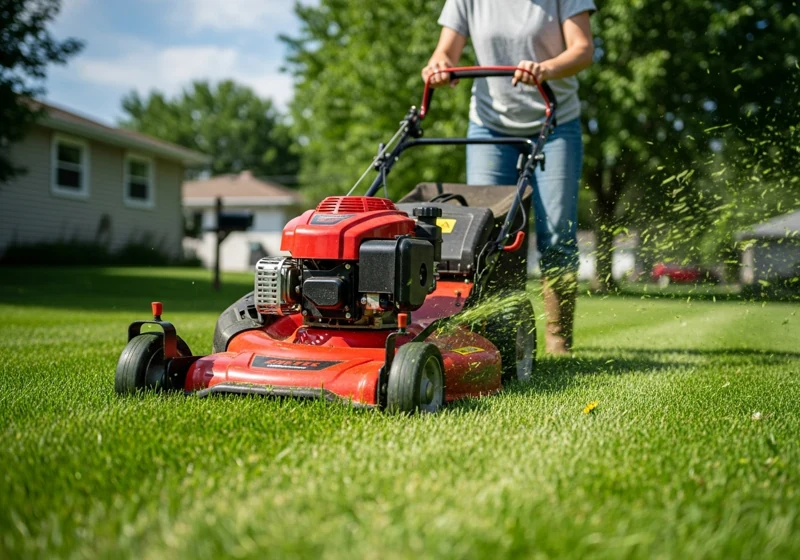
Your basic gas push mower is where most of us started, and honestly? For smaller yards under half an acre, it’s still one of the smartest choices you can make. These machines are simple, dependable, and won’t break the bank.
I learned this one the hard way back in my early days. A customer insisted on buying a self-propelled mower for her quarter-acre lot because “it seemed easier.” Three years later, she was back asking for a simple push mower. Why? The self-propelled system had broken twice, costing her $180 in repairs, while her neighbor’s basic push mower just kept running.
What Makes Gas Push Mowers Work
The beauty of a gas push mower lies in its simplicity. You’ve got an engine, a blade, wheels, and a handle. That’s it. No complex transmission systems, no drive belts to replace, no variable speed controls to malfunction. When something does go wrong, your local small engine repair shop can usually fix it for under $100.
Most quality gas push mowers today come with engines ranging from 140cc to 190cc. Here’s what that means in real terms: a 140cc engine handles normal grass just fine, while a 190cc engine powers through thick spring growth without bogging down. I typically recommend the 160cc range for most homeowners because it’s the sweet spot between power and fuel efficiency.
Best Gas Push Mower Features to Look For
After testing dozens of models, here are the features that actually matter:
Deck Material: Look for steel decks, period. I don’t care how advanced they claim their composite materials are; I’ve seen too many plastic decks crack after a few seasons. A good steel deck might get a few dings, but it’ll outlast you.
Wheel Size: Get the biggest wheels you can find, especially the rear wheels. Those tiny 8-inch wheels will have you fighting every bump and dip in your yard. Most quality mowers now come with 11-inch rear wheels, and trust me, you’ll feel the difference.
Height Adjustment: Single-point height adjustment is worth paying extra for. If you have to adjust each wheel individually, you’ll either never change cutting heights or you’ll get frustrated trying to get them even.
Mulching Capability: Even if you prefer bagging, get a mower that can mulch. It gives you options, and mulching saves time while feeding your lawn.
Now, you might be thinking, “Jake, what about brand recommendations?” For push mowers, I consistently see great results from Honda’s HRN series (around $400-500), Toro’s Recycler models ($350-450), and if you’re on a tight budget, the Craftsman M105 ($280-320) has impressed me lately.
Self Propelled Gas Lawn Mower: Power Meets Convenience
Here’s where things get interesting. A self-propelled gas lawn mower takes that reliable push mower concept and adds a transmission system that moves the mower forward for you. Sounds perfect, right? Well, it is perfect, but only if you need what it offers.
I always tell customers to be honest about their situation. If you’re dealing with slopes, thick grass, or you simply don’t want to push 70+ pounds of mower around, self-propulsion makes sense. But if your yard is relatively flat and manageable, you’re paying extra for a feature that might actually slow you down.
Front Wheel Drive vs Rear Wheel Drive
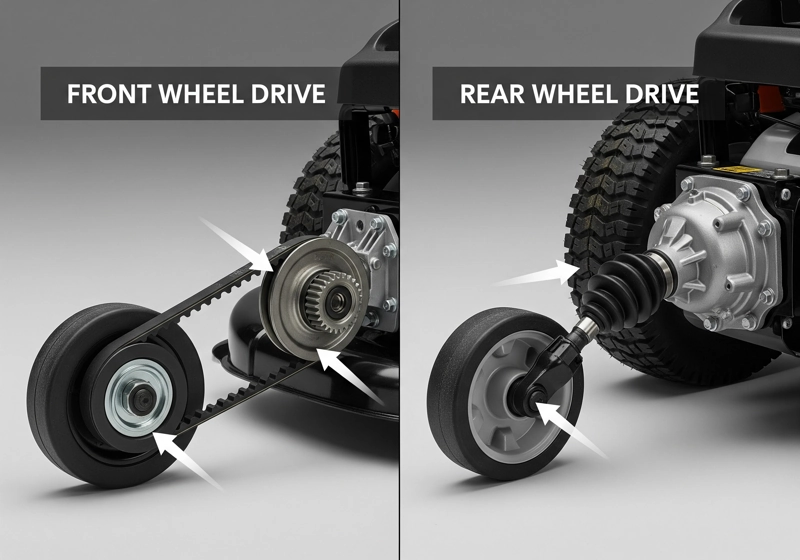
This is where I see the most confusion. Front wheel drive (FWD) self-propelled mowers are lighter and less expensive, typically running $450-600 for quality models. They work great on flat ground and gentle slopes. But here’s the catch: when you tip the mower back to empty the bag or navigate obstacles, you’re lifting the drive wheels off the ground. Suddenly, your self-propelled mower becomes a really heavy push mower.
Rear wheel drive (RWD) models cost more, usually $550-750, but they make sense if you have hills or frequently bag your clippings. The drive wheels stay planted when you tip the mower back, so you maintain traction when you need it most.
Personal preference? I’m a Rear Wheel Drive guy. After watching customers struggle with FWD mowers on anything steeper than their driveway, I’d rather pay the extra $100 upfront than deal with the frustration later.
Variable Speed: Worth It or Gimmick?
Most self propelled gas lawn mowers now offer variable speed control, usually through a lever or squeeze mechanism. This lets you match the mower’s pace to your walking speed, which sounds great in theory.
In practice, I’ve found that most people set it to one speed and leave it there. The variable speed is nice for navigating around flower beds or when you’re moving slower in thick grass, but it’s not a make-or-break feature. If choosing between a simpler single-speed model and a variable speed version, I’d take the simpler one and save the $50-75 difference.
Self Propelled Gas Lawn Mower Maintenance Reality
Here’s what the sales brochure won’t tell you: self-propelled systems require more maintenance. You’ll need to adjust or replace drive cables every few years, and the transmission oil should be checked annually. Budget an extra $25-50 per year in maintenance compared to a push mower. For comprehensive maintenance schedules and troubleshooting tips, check our [complete lawn mower maintenance guide.
That said, quality models from Honda (HRX series), Toro (Personal Pace), and Ariens (Classic series) are built to handle this extra complexity. I’ve seen 10-year-old self-propelled mowers still running strong with basic maintenance.
Gas Riding Lawn Mowers: When Size Matters
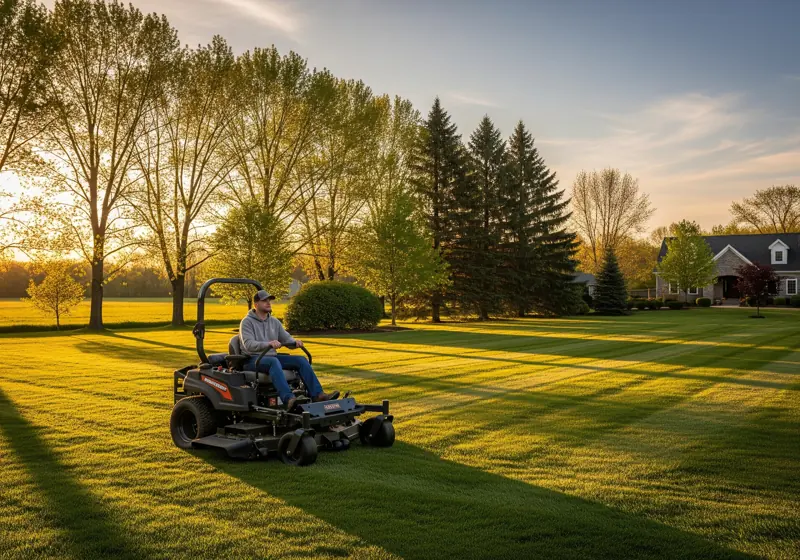
Let’s be real about when you need gas riding lawn mowers: if you’ve got more than an acre to cut, or you physically can’t handle pushing a walk-behind mower for 45+ minutes. Don’t let anyone shame you into thinking riding mowers are lazy. Your back and your time are worth something.
I made the mistake early in my business of trying to cut a 2-acre property with a walk-behind mower. Two hours later, I was exhausted and only halfway done. That’s when I understood why homeowners with larger properties invest in riders.
Lawn Tractors vs Zero Turn Mowers
This is probably the biggest decision you’ll face in the riding mower category. Traditional lawn tractors look like small tractors with the cutting deck underneath. They’re stable, familiar to operate, and typically cost $1,200-2,500 for homeowner models. To understand the key differences between riding and push mowers, read our detailed comparison guide.
Zero-turn mowers have their cutting deck out front and use independent wheel motors for incredible maneuverability. They cut mowing time significantly, but they come with a learning curve and usually start around $2,500 for entry-level models.
For most homeowners with 1-3 acres, a quality lawn tractor makes more sense. The Honda HF2417 ($1,800-2,000), Cub Cadet XT1 ($1,400-1,600), and Troy-Bilt Pony ($1,200-1,400) all deliver solid performance without breaking the budget.
Engine Size for Riding Mowers
Here’s where engine size really matters. Unlike walk-behind mowers, where a 160cc engine handles most situations, riding mowers need more power to drive both the cutting system and the wheels.
For properties up to 2 acres, a single cylinder engine around 17-19 HP works fine. Once you get into 3+ acres or dealing with thick grass and hills, step up to a twin cylinder engine in the 20-24 HP range. Twin cylinder engines run smoother, last longer, and handle tough conditions better. Learn more about different engine types in our comprehensive engine guide.
Cutting Deck Considerations
Riding mower decks range from 38 inches up to 54+ inches for homeowner models. Here’s my rule of thumb: get the largest deck that fits through your gates and storage areas. A 42-inch deck is the sweet spot for most suburban properties, while 46-50-inch decks make sense for larger, more open areas.
Fabricated decks (welded steel) cost more than stamped decks but last significantly longer. If you plan to keep the mower more than 5-7 years, the fabricated deck is worth the extra investment.
Best Gas Lawn Mower by Yard Size
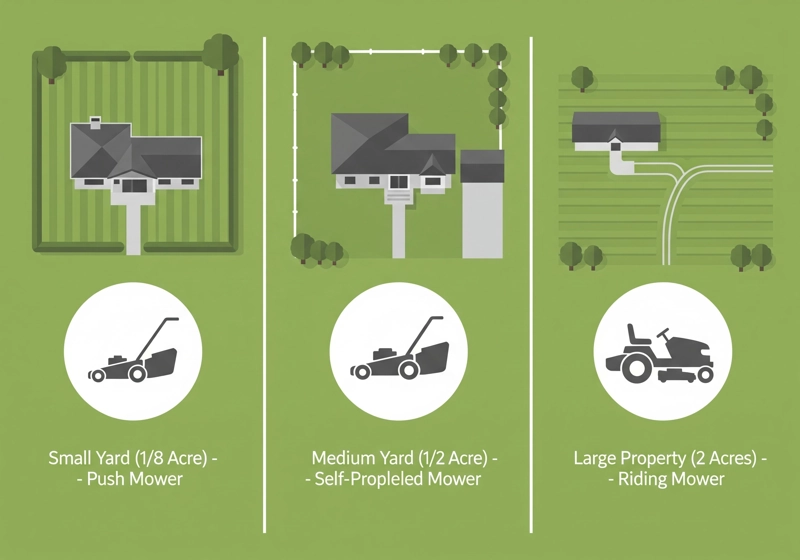
After two decades of matching mowers to properties, here’s what I recommend based on yard size:
Under 1/4 acre: Basic gas push mower with 140-160cc engine. The Honda HRN166VKA or Toro Recycler 22 are solid choices. You’ll spend 15-20 minutes cutting, get good exercise, and keep maintenance simple.
1/4 to 1/2 acre: This is where you have options. A larger push mower (160-190cc) still works great if you don’t mind 25-35 minutes of cutting. If time is tight or you have slopes, consider a self-propelled gas lawn mower like the Honda HRX217VKA.
1/2 to 1 acre: Self-propelled makes sense here, especially rear wheel drive if you have any hills. The Toro Personal Pace or Ariens Classic models handle this size property well. Budget 30-45 minutes for cutting.
1 to 3 acres: Time for gas riding lawn mowers. A good lawn tractor with a 42-46 inch deck cuts your time to 45-75 minutes versus hours with a walk-behind. The Honda HF2417 or Cub Cadet XT1 series works well here.
3+ acres: Zero-turn or commercial-grade lawn tractor territory. At this size, time savings become significant. A 48-52 inch zero turn can cut a 3-acre property in under an hour.
Gas Powered Lawn Mower Maintenance Essentials
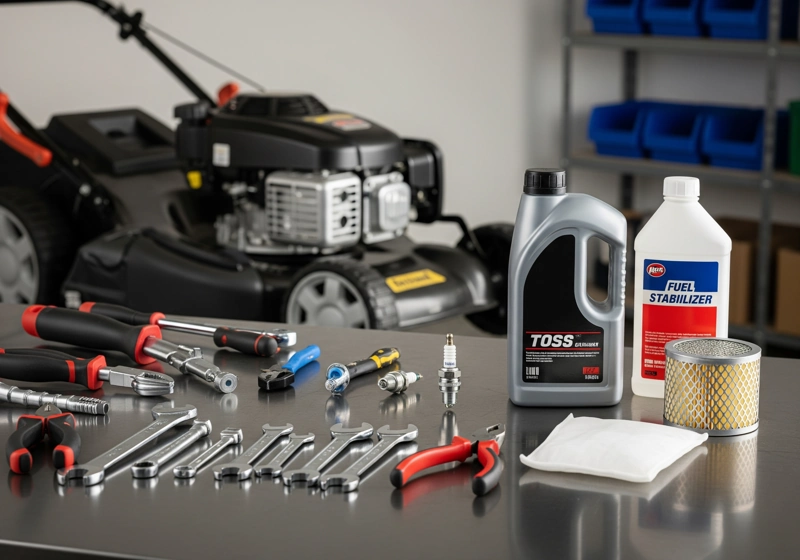
Here’s where owning any gas powered lawn mower gets real. Unlike electric models, gas engines need regular attention. But don’t panic – we’re talking about 30 minutes twice a year for basic maintenance.
Seasonal Maintenance Schedule
Spring startup: Fresh gas, oil change, spark plug check, air filter inspection. Total time: 20-30 minutes. Cost: $25-40 in materials.
Mid-season: Check and sharpen blade, clean air filter, top off oil. Time: 15 minutes monthly.
Fall prep: Stabilize fuel, final oil change, clean deck thoroughly, check tire pressure. Time: 30-40 minutes. Cost: $30-45.
The biggest mistake I see is people running the same oil all season. Change it twice: once in spring, once in fall. Good oil costs $8-12 per change and prevents hundreds in engine repairs. For detailed steps on proper oil changes, check out our comprehensive oil change guide.
Fuel System Care
Here’s something that’ll save you money: always use fresh gas with proper stabilizer. Gas starts breaking down after 30 days, and ethanol blends attract moisture. I’ve seen more fuel system problems in the last five years than the previous fifteen, and it’s almost always bad gas.
For most homeowners, buy gas monthly and add STA-BIL or a similar stabilizer every time. For winter storage, run the engine dry or add stabilizer and run it for 10 minutes to circulate treated fuel through the system.
Blade Maintenance Reality
Sharp blades make all the difference. Dull blades tear grass instead of cutting cleanly, leaving brown tips and weakening your lawn. I recommend checking blade sharpness monthly during cutting season and sharpening 2-3 times per year. Learn the proper technique with our step-by-step blade sharpening guide.
You can sharpen blades yourself with a file or angle grinder, but most lawn equipment dealers charge $10-15 to sharpen and balance them properly. For safety and results, I usually recommend professional sharpening unless you’re comfortable with power tools.
Choosing the Right Gas Lawn Mower: Your Decision Framework
After helping thousands of customers, I’ve developed a simple framework for choosing the right gas lawn mower. For an even more comprehensive selection process covering all mower types, see our complete homeowner’s guide to choosing lawn mowers:
Start with your yard size and terrain. Flat quarter-acre lot? Push mower. Hilly half-acre? Self-propelled. Two acres with obstacles? Riding mower.
Factor in your physical situation honestly. There’s no shame in choosing easier options. I’d rather see you enjoy lawn care than dread it.
Consider your time constraints. If you only have 30 minutes on Saturday morning, choose accordingly. A riding mower might seem excessive for one acre, but if it fits your schedule, it’s the right choice.
Budget for the total cost of ownership. That $300 push mower needs $50-75 annually in maintenance. The $1,500 riding mower needs $100-150. Factor this into your decision.
Think about storage and transport. Make sure your choice fits your garage, truck, or trailer. I’ve seen people buy mowers they can’t store properly or get serviced easily.
Now, you might be wondering about specific brand recommendations. For reliability and service support, Honda consistently impresses me across all categories. Toro offers excellent value and innovation. Cub Cadet and Troy-Bilt provide solid budget options. Ariens builds commercial-quality homeowner machines. For detailed brand comparisons and reviews, check our comprehensive brand guide.
The truth is, any quality gas lawn mower will serve you well with proper maintenance. Choose based on features, fit, and local dealer support rather than just brand loyalty.
Final Thoughts on Gas Lawn Mowers
Twenty-two years ago, I thought all mowers were basically the same. I was wrong. The right gas lawn mower makes lawn care faster, easier, and more enjoyable. The wrong one turns it into a weekly battle.
Take your time with this decision. Visit dealers, start some engines, and push or sit on different models. Ask about local service support because even the best mowers need occasional attention. And remember, the most expensive mower isn’t always the best choice for your specific situation.
Whether you choose a simple gas push mower, a self propelled gas lawn mower, or gas riding lawn mowers, the key is matching the machine to your needs. Your lawn doesn’t care what you paid; it only cares that you’re cutting it regularly with sharp blades.
Have questions about specific models or situations? Most reputable dealers will let you demo mowers or at least start them up. Take advantage of that. And honestly? That’s perfectly fine. Your decision should be based on how the mower feels to you, not what worked for your neighbor or what some review site recommended.
Now get out there and find your perfect match. Your lawn is waiting.
Before you make your final decision, you might want to explore how gas mowers compare to other options. Check out our complete guide to gas vs. electric mowers to see which power source works best for your situation, or browse our [comprehensive overview of all lawn mower types](link-to: Types of Lawn Mowers: A Comprehensive Guide) to make sure you’re considering every option.
A self-propelled gas lawn mower is a walk-behind mower with a transmission system that moves the machine forward automatically, so you don’t have to push it. You simply guide the mower while it propels itself at your walking pace. These mowers typically have either front-wheel drive (FWD) or rear-wheel drive (RWD) systems and come with variable speed controls on most models. They’re ideal for yards between half an acre to one acre, especially if you have slopes or thick grass conditions.
The main difference is effort and control. With a push mower, you provide all the forward motion by pushing the entire weight of the machine (typically 60-80 pounds). A self-propelled mower has a drive system that moves the mower forward for you – you just walk behind and steer. Push mowers are simpler, less expensive ($280-500), and require less maintenance. Self-propelled mowers cost more ($450-750) but reduce physical effort significantly, especially on hills or in thick grass. For yards under quarter-acre on flat terrain, push mowers often make more sense.
Rear-wheel drive self-propelled mowers are generally better for most homeowners. Here’s why: when you tip the mower back to empty the bag or navigate obstacles, rear-wheel drive keeps the drive wheels on the ground, maintaining traction. Front-wheel drive loses power when tilted back because you lift the drive wheels off the ground. RWD models also handle hills and slopes much better. The trade-off is cost – RWD typically costs $100-150 more than FWD. If your yard is completely flat with no bagging, FWD can work fine and save money.
Quality gas lawn mowers typically last 8-12 years with proper maintenance, though I’ve seen well-maintained Honda and Toro mowers still running strong after 15+ years. The key factors are regular oil changes (twice per season), fresh fuel with stabilizer, annual tune-ups, and keeping blades sharp. Push mowers generally last longer than self-propelled models because they have fewer moving parts. Riding mowers average 10-15 years but require more maintenance. Budget models may only last 5-7 years, while commercial-grade homeowner mowers often exceed 12 years with proper care.
Self-propelled gas lawn mowers make the most sense for yards between half an acre and one acre. Below half an acre, a quality push mower is usually sufficient and more cost-effective. Above one acre, you should consider a riding mower for time efficiency. However, terrain matters more than size sometimes – if you have a quarter-acre yard with steep slopes or consistently thick grass, self-propulsion becomes valuable regardless of size. Also consider your physical situation – if pushing 70+ pounds of mower for 30+ minutes isn’t comfortable, self-propulsion makes sense even on smaller properties.
