
Riding vs. Push Lawn Mowers: What’s the Difference?
Let me tell you, after 15 years in the lawn mower business, this is hands down the most common question I get from homeowners. Just last week, a neighbor stopped by my Saturday morning coffee spot asking, “Mike, I’m tired of pushing that old mower around, but is a riding mower worth it?”
Table of Contents
▼- Understanding Push Lawn Mowers: The Foundation of Lawn Care
- The Three Types of Push Mowers
- Push Mower Advantages That Matter
- Exploring Riding Lawn Mowers: Power and Convenience Combined
- Types of Riding Mowers You’ll Encounter
- When Riding Mowers Make Perfect Sense
- Size and Yard Coverage: The Make-or-Break Factor
- Measuring Your Property Correctly
- Cutting Width Impact on Efficiency
- Maintenance Requirements: The Hidden Time and Cost Factors
- Push Mower Maintenance Reality
- Riding Mower Maintenance Complexity
- Seasonal Storage Considerations
- Cost Analysis: Beyond the Sticker Price
- Initial Investment Ranges
- Ongoing Cost Considerations
- Efficiency and Time Management: The Real-World Comparison
- Mowing Speed Differences
- Trimming and Detail Work
- Making the Right Choice for Your Situation
- When Push Mowers Are the Clear Winner
- When Riding Mowers Make Financial Sense
- The Bottom Line: Choosing Your Perfect Match
Here’s the thing – choosing between a riding mower and a push mower isn’t just about convenience. It’s about matching the right tool to your specific yard, budget, and lifestyle. I’ve helped thousands of customers make this decision, and I’ve learned that the “best” choice depends on factors most people don’t even think about initially.
In this guide, I’ll walk you through everything you need to know about riding vs. push lawn mowers, from the obvious differences to the hidden costs that catch homeowners off guard. By the end, you’ll know exactly which type makes sense for your situation – and more importantly, why.
Understanding Push Lawn Mowers: The Foundation of Lawn Care
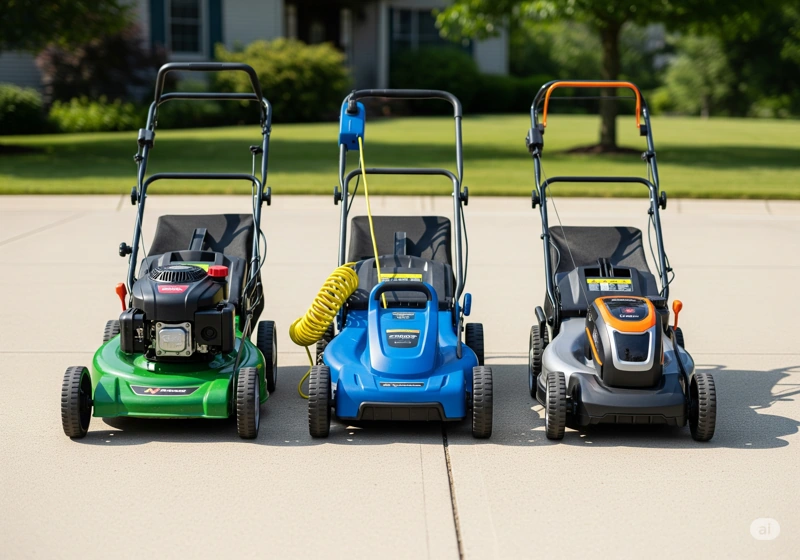
Push mowers are where most of us start our lawn care journey, and honestly, they’re still the backbone of suburban yard maintenance. When I say “push mower,” I’m talking about any mower you walk behind – whether it’s a traditional gas-powered model, an electric corded unit, or one of those new battery-powered machines that are taking over the market.
The Three Types of Push Mowers
In my experience, homeowners often get confused about push mower categories, so let me break it down simply:
Gas-powered push mowers are your workhorses. They typically range from 140cc to 190cc engines and can handle thick grass, wet conditions, and longer cutting sessions without breaking a sweat. These small engines are specifically designed for outdoor power equipment and offer reliable performance for residential use.. I use a Honda HRX217 on my 0.75-acre lot, and it’s never let me down.
Electric corded mowers are perfect for smaller yards where you don’t mind the extension cord dance. They’re quieter than gas models, require minimal maintenance, and start reliably every time. The main limitation? You’re tethered to your power outlet, which usually means yards under a quarter-acre.
Battery-powered push mowers have revolutionized small to medium yard care. Modern lithium-ion batteries from brands like EGO and Greenworks can power through 30-45 minutes of cutting, which translates to about half an acre for most homeowners. The technology has improved dramatically – I’ve tested units that rival gas mowers in cutting power.
Push Mower Advantages That Matter
Here’s what I tell customers about why push mowers might be their best choice: First, they’re incredibly maneuverable. You can navigate around flower beds, under deck overhangs, and through tight spaces that would give a riding mower fits. My golden retriever, Max, has created quite a few obstacle courses in our backyard with his digging habits, and a push mower handles them without issue.
Storage is another huge advantage. Most push mowers fold up and fit in a corner of your garage or shed. Compare that to a riding mower, which basically needs its own parking space.
From a fitness perspective – and I know this isn’t why you’re shopping for mowers – pushing a mower for 30-45 minutes gives you a decent workout. Some of my customers prefer this to gym time.
Exploring Riding Lawn Mowers: Power and Convenience Combined
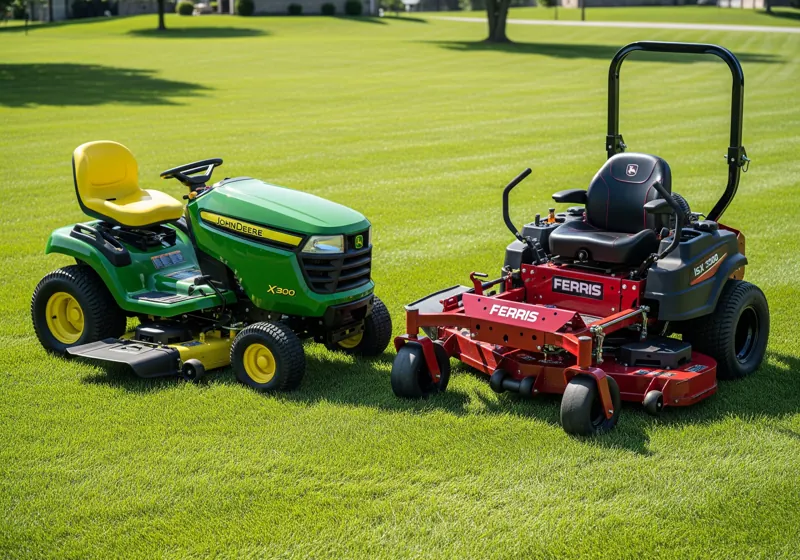
Riding mowers represent a significant step up in both capability and investment. When I worked as a service manager, I noticed that customers who made the jump to riding mowers rarely looked back – but the ones who bought too early often felt buyer’s remorse.
Types of Riding Mowers You’ll Encounter
Lawn tractors are the most common type I see in suburban driveways. They look like mini farm tractors, with the engine in front and a comfortable seat. Cutting decks typically range from 38 to 48 inches, and they’re designed for yards between one and three acres. Brands like Craftsman and Husqvarna dominate this category.
Zero-turn mowers are the sports cars of the mowing world. Instead of a steering wheel, they use individual wheel controls (usually levers or lap bars) that let you turn on a dime. They’re faster and more maneuverable than tractors but require a learning curve. I’ve seen plenty of homeowners accidentally carve up their landscaping during the first few uses.
Garden tractors are the heavy-duty option, built more like small farm equipment. They’re overkill for most suburban yards but perfect if you’ve got acreage or want to use attachments like snow blades or cart haulers.
When Riding Mowers Make Perfect Sense
Let me be honest with you – there’s a magic number where riding mowers transition from luxury to necessity, and it’s around one acre. I’ve watched too many homeowners struggle with push mowers on large properties, turning what should be a two-hour job into an all-day ordeal.
Time efficiency is the biggest factor. My neighbor has a 1.5-acre lot and switched from a push mower to a 42-inch lawn tractor last year. His mowing time dropped from three hours to about 75 minutes. When you factor in his busy schedule with two teenagers, that time savings is priceless.
Physical considerations matter too. I’ve helped several customers in their 50s and 60s make the transition, not because they’re lazy, but because pushing a mower for hours started affecting their knees and back due to ergonomic factors. There’s no shame in admitting that comfort and reduced physical strain are important factors.
Size and Yard Coverage: The Make-or-Break Factor
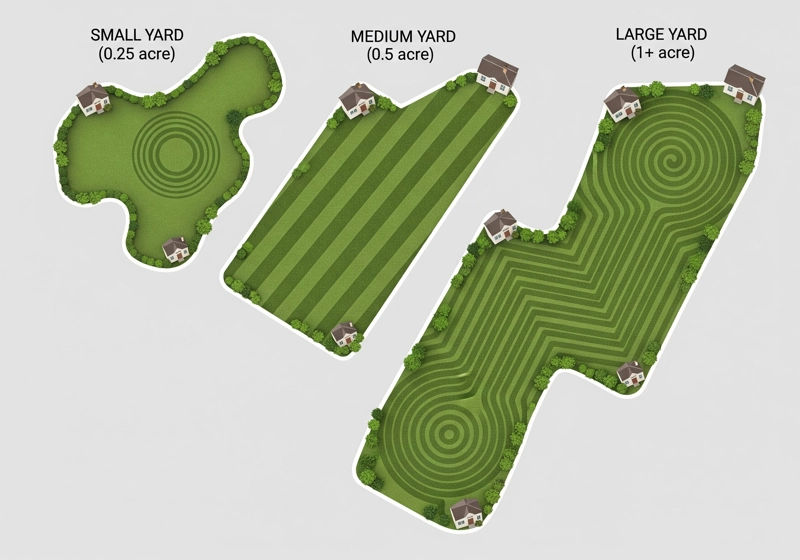
Here’s where I see the most mistakes in mower selection. Homeowners either overestimate their yard size and buy too much machinery, or underestimate and end up frustrated with their choice.
Measuring Your Property Correctly
Most people guess their yard size, and they’re usually wrong. I always recommend actually measuring or checking your property survey. A “big” suburban lot might be half an acre, while what feels like a “small” yard could be a third of an acre – enough to justify a riding mower if your budget allows.
For push mowers, the sweet spot is anything under three-quarters of an acre. Beyond that, you’re looking at 90+ minutes of mowing time, which starts to feel like a chore rather than yard maintenance.
Riding mowers shine on properties over one acre, but I’ve installed plenty of 38-inch lawn tractors for customers with smaller yards who value convenience over cost savings.
Cutting Width Impact on Efficiency
This is where the math gets interesting. A typical push mower has a 20-22 inch cutting deck. A basic riding mower starts at 38 inches. That difference translates to significantly fewer passes across your yard.
On my 0.75-acre lot, I make roughly 40 passes with my 22-inch Honda. The same area would require about 23 passes with a 38-inch riding mower. When you factor in the faster ground speed of riding mowers, you’re looking at dramatic time savings.
Maintenance Requirements: The Hidden Time and Cost Factors
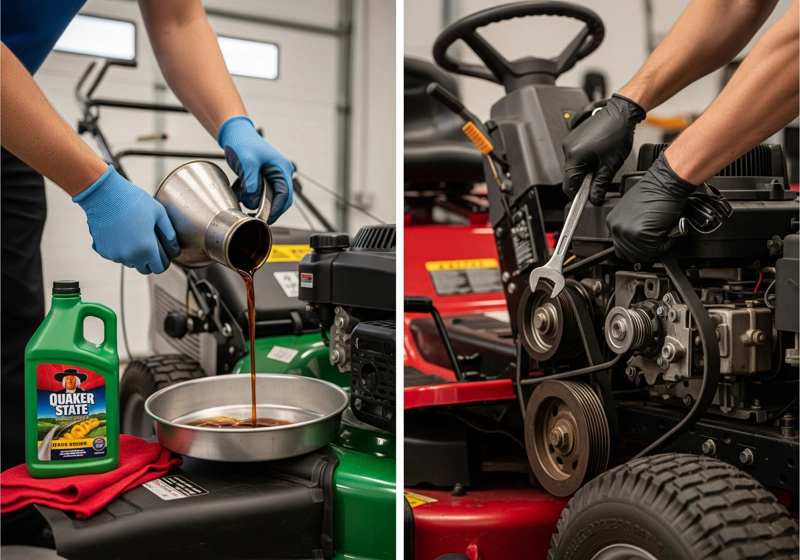
This is where many homeowners get surprised. The maintenance requirements between push and riding mowers are dramatically different, and I’ve seen plenty of customers unprepared for the reality.
Push Mower Maintenance Reality
Push mowers are relatively simple machines. Gas models need regular oil changes (every 25-50 hours of use), air filter cleaning, spark plug replacement, and annual blade sharpening. For most homeowners, that translates to one major service per year, usually in spring.
Electric push mowers require even less – basically blade sharpening and keeping the deck clean. Battery models need proper battery care, but that’s mostly about storage practices and not overcharging.
I always tell customers that a quality push mower should give you 8-10 years of reliable service with basic maintenance. The key is not letting small issues become big problems.
Riding Mower Maintenance Complexity
Riding mowers are more like small cars than simple tools. They have hydraulic systems, more complex engines, drive belts, and multiple grease points. The maintenance schedule is more involved – oil changes every 25 hours, transmission fluid checks, belt tension adjustments, and more frequent blade maintenance due to the larger cutting deck.
Here’s what I learned the hard way: many homeowners buy riding mowers thinking they’ll do the maintenance themselves, then end up bringing them to dealers like me every spring. A typical riding mower service runs $200-300 annually, compared to $75-100 for a push mower.
Seasonal Storage Considerations
Storage becomes critical with riding mowers. They need more space, proper fuel stabilization, and often battery maintenance over winter. I’ve seen too many expensive riding mowers develop problems simply because they weren’t stored correctly.
Push mowers are much more forgiving. Clean the deck, add fuel stabilizer, and find a dry corner of the garage. With electric models, you don’t even need to worry about fuel issues.
Cost Analysis: Beyond the Sticker Price
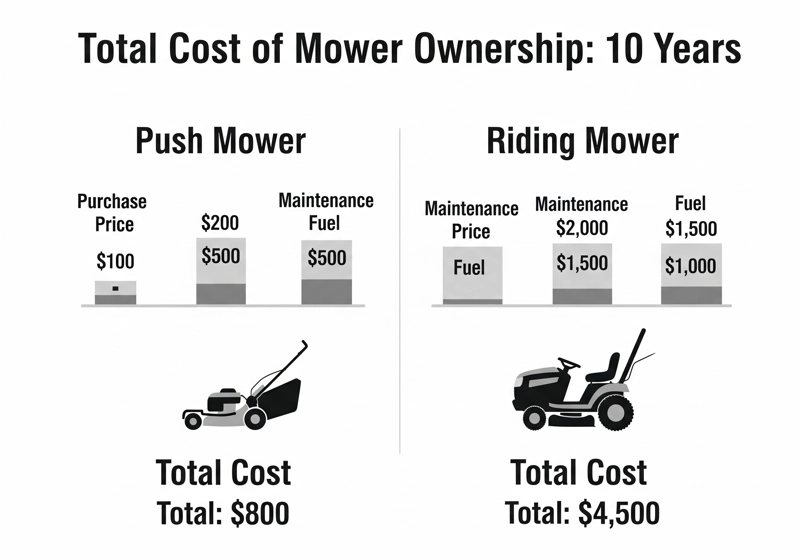
Let me walk you through the real cost differences, because the purchase price is just the beginning.
Initial Investment Ranges
Quality push mowers range from $300 for a basic gas model to $600 for premium battery-powered units. You can spend more for commercial-grade equipment, but most homeowners don’t need that level of durability.
Riding mowers start around $1,500 for basic lawn tractors and quickly climb to $3,000-5,000 for quality zero-turns. The price jump is significant, and it’s the first reality check for many customers.
Ongoing Cost Considerations
Here’s where the math gets interesting. Push mowers typically cost $50-100 annually in maintenance and fuel. Riding mowers run $300-500 per year when you factor in fuel, oil, filters, belts, and professional servicing.
Over a 10-year ownership period, a push mower might cost $1,500 total (including purchase), while a riding mower could easily reach $6,000. For some homeowners, that’s a worthwhile investment in time savings and convenience. For others, it’s hard to justify.
Efficiency and Time Management: The Real-World Comparison
Time is money, and this is where individual circumstances matter.
Mowing Speed Differences
A typical push mower covers ground at 2-3 mph, depending on your walking pace and grass conditions. Riding mowers cruise at 4-6 mph, with zero-turns capable of even higher speeds on straight runs.
But here’s the thing, most people don’t consider setup and cleanup time. A push mower is grab-and-go. Pull the cord (or press the button), and you’re cutting grass. Riding mowers require a few minutes of pre-checks, especially early in the season.
Trimming and Detail Work
This is where riding mowers show their limitations. You’ll still need a string trimmer, and you might find yourself doing touch-up work with a smaller mower around obstacles. I always remind customers that a riding mower doesn’t eliminate all the other lawn maintenance tasks.
Making the Right Choice for Your Situation
After helping thousands of homeowners make this decision, I’ve identified some key factors that usually point toward the right choice.
When Push Mowers Are the Clear Winner
If your yard is under half an acre, relatively flat, and you don’t mind 45-60 minutes of mowing time, a quality push mower is probably your best bet. The cost savings over time are substantial, and modern gas and battery models are remarkably capable.
I particularly recommend push mowers for homeowners who take pride in the precision work – trimming around landscaping, managing grass height variations, and maintaining those crisp edge lines that make a lawn look professionally maintained.
When Riding Mowers Make Financial Sense
The break-even point varies by individual, but I generally see riding mowers become cost-effective on properties over one acre or for homeowners whose time is genuinely limited. If you’re paying a landscaping service $150+ monthly, a quality riding mower can pay for itself in two seasons.
Physical limitations are another valid consideration. I’ve helped customers with arthritis, back problems, and other health issues make the transition to riding mowers, and the quality of life improvement is often dramatic.
For a complete breakdown of all available options, check out our comprehensive guide to different mower types.
The Bottom Line: Choosing Your Perfect Match
Here’s what it comes down to – there’s no universally “best” choice between riding and push mowers. The right decision depends on your yard size, budget, available time, physical capabilities, and personal preferences.
If you’re still on the fence, I recommend starting with a quality push mower and upgrading later if needed. You’ll learn a lot about your lawn care preferences in the first year, and that knowledge will help you make a more informed decision about a potential riding mower purchase.
Remember, both types of mowers can give you a beautiful lawn when properly maintained and operated. The key is choosing the one that fits your specific situation and then taking good care of it. Trust me on this one – a well-maintained push mower will outperform a neglected riding mower every time.
Whatever you choose, you’re taking an important step toward better lawn care. And honestly? That’s something to be proud of, whether you’re walking behind your mower or riding in comfort.
It depends on your yard size and needs. Push mowers are better for yards under 0.75 acres – they’re more affordable, easier to maintain, and give you better precision around landscaping. Riding mowers excel on properties over 1 acre where time savings justify the higher cost. In my 15 years of experience, the “better” choice always comes down to matching the tool to your specific situation rather than one being universally superior.
The magic number is around 1 acre. Once you’re spending more than 90 minutes mowing with a push mower, a riding mower starts making financial and practical sense. I tell customers that if your mowing session feels like a workout you didn’t sign up for, or if you’re dreading yard work because of the time commitment, it’s time to consider upgrading.
The biggest drawbacks are cost and maintenance complexity. You’re looking at $1,500-$5,000 upfront plus $300-500 annually in maintenance versus $50-100 for push mowers. They also need more storage space, can’t handle tight spaces well, and you’ll still need a trimmer for detail work. Plus, they’re more likely to compact soil if you mow when it’s too wet.
Absolutely, but only on larger properties. A riding mower can cut your mowing time by 50-60% on yards over an acre. However, on smaller properties, the time savings might only be 15-20 minutes, which doesn’t justify the extra cost for most homeowners. The real-time savings come from the faster ground speed and wider cutting deck working together.
They’re more complex than push mowers. Think of them like small cars – they need regular oil changes, belt adjustments, hydraulic fluid checks, and multiple grease points. Most homeowners end up bringing them to dealers for annual service, which runs $200-300. If you’re handy with tools, you can do basic maintenance yourself, but expect to spend more time and money than with a simple push mower.
For the right situation, absolutely. If you have over an acre, limited time, or physical limitations that make push mowing difficult, a riding mower pays for itself in convenience and time savings. But if you’re trying to justify one for a half-acre suburban lot just because you don’t like pushing a mower, the math usually doesn’t work out. Honest answer? Most people who buy riding mowers for convenience on smaller yards end up regretting the ongoing costs.
