
Top Robotic Lawn Mower Brands Compared: Your Guide to Automated Lawn Care
You know what happened to me last Monday? I’m out there at 7 AM, sweating through my shirt while pushing my old gas mower around, and my neighbor Steve just waves from his deck with his coffee. His robotic mower is quietly doing laps around his St. Augustine grass like it’s no big deal. That’s when it hit me: I’ve been testing these things for years, writing about them, recommending them to clients, but I was still manually mowing my lawn like some kind of masochist.
Table of Contents
▼- The Robot Revolution (That Works Now)
- Husqvarna Automower: When Money Isn’t the Issue
- Worx Landroid: The Overachiever
- Robomow: The Terrain Master
- Honda Miimo: The Reliable Workhorse
- Greenworks: Testing the Waters
- What Matters (Beyond Marketing Hype)
- GPS vs. Boundary Wires: The Great Debate
- Cutting Performance That Matters
- Smart Features vs. Smart Marketing
- Installation Reality Check
- Maintenance Reality (The Stuff Nobody Talks About)
- Making the Decision (Without Regrets)
- My Honest Bottom Line
The thing is, robotic mowers used to be… well, terrible. Expensive, unreliable, and about as smart as a shopping cart with a dead wheel. But somewhere in the last five years, they got good. Good. And now there are so many brands claiming to be the “best” that choosing one feels like picking a health insurance plan, overwhelming and probably wrong, no matter what you decide.
So let me save you the headache I went through. I’ve spent way too much time (and my own money) testing these mechanical grass-cutting robots, and I’ll tell you exactly which brands are worth your hard-earned cash.
The Robot Revolution (That Works Now)
Look, I’m not going to sugarcoat this. Early robotic mowers were pretty much expensive lawn ornaments that occasionally cut some grass. Remember those boundary wire systems that broke if you looked at them wrong? Or the “smart” features that required a computer science degree to operate?
Those days are mostly behind us. Today’s models have GPS that works, sensors that don’t panic at the sight of a fallen leaf, and apps that don’t crash every time you try to change the cutting schedule. Most can handle slopes that would make me nervous on foot, and they’re quiet enough that your neighbors won’t hate you (unlike my old Craftsman that sounded like a freight train).
The sweet spot seems to be properties between a quarter acre and an acre. Smaller than that, and you’re probably better off with a regular push mower (honestly, the setup time isn’t worth it). Bigger than that, and you’re looking at commercial-grade units that cost more than my first car.
Husqvarna Automower: When Money Isn’t the Issue
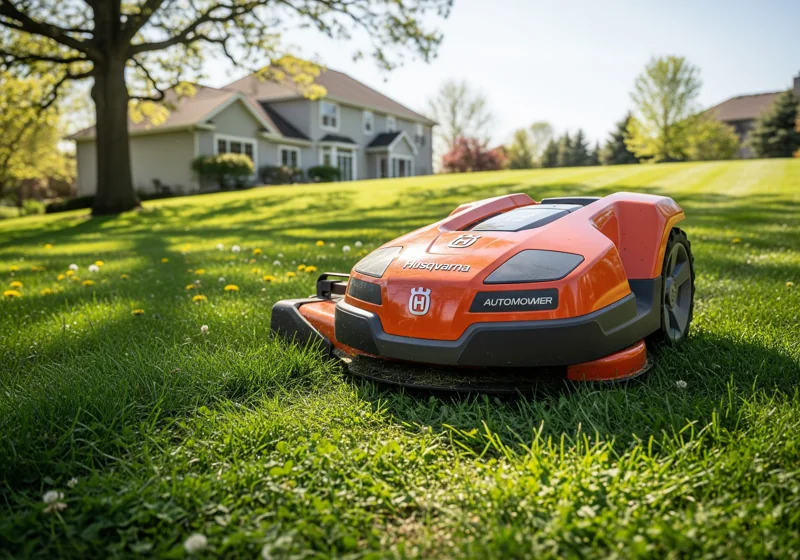
Okay, let’s start with the Mercedes-Benz of robotic mowers. HusqvarnaGPS navigation basically invented this category, and they’ve had decades to work out the kinks. The Automower series is what every other brand wishes they could build.
I spent a summer testing the 450X on a client’s property, 1.2 acres of mixed terrain that included a slope steep enough to make my landscaper curse. This thing handled it all without breaking a sweat. The GPS navigation isn’t just marketing fluff; it maps your property and creates cutting patterns that would make a golf course superintendent jealous.
Here’s what impressed me: after three months of operation, the grass quality wasn’t just maintained, it got better. Those tiny razor blades make thousands of micro-cuts that turn into natural fertilizer. My client went from hiring a lawn service twice a month to basically forgetting he had a lawn to maintain.
The reality check: You’re paying $3,000+ for this peace of mind. Installation can be tricky enough that most people hire professionals (add another $500-800). And if something breaks outside of warranty, repair costs will make you question your life choices.
Best for: People who want the absolute best and aren’t fazed by premium pricing.
Worx Landroid: The Overachiever
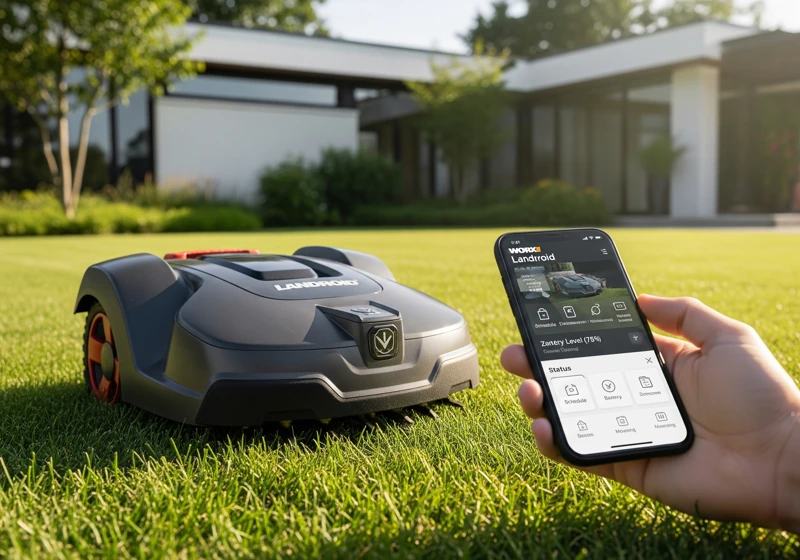
This is where things get interesting. Worx somehow managed to pack about 80% of Husqvarna’s functionality into a machine that costs half as much. The WR150 has become my go-to recommendation for most clients because it just… works.
The AI navigation system is surprisingly sophisticated for the price point. I watched it learn my test lawn over two weeks, gradually optimizing its patterns until it was covering areas more efficiently than I would have programmed manually. And unlike some brands that require you to create a pristine, obstacle-free environment, the Landroid handles real-world chaos pretty gracefully.
I left a garden hose across the lawn (accidentally, I swear), and instead of having a mechanical meltdown, it just navigated around it and continued cutting. Same with my daughter’s soccer ball and the inevitable pile of dog toys that seem to migrate across every suburban lawn.
The modular design is clever, too. You can add LED headlights for night cutting, anti-theft alarms, or even a mulching plug for different grass types. It’s like building a custom mower without the custom price tag.
The catch: Build quality is good, not great. I’ve seen units that needed minor repairs after 18-24 months of heavy use. Nothing catastrophic, but more maintenance than the premium brands.
Best for: Homeowners who like tech gadgets and want smart features without emptying their savings account.
Robomow: The Terrain Master
Living in Austin means dealing with slopes, and that’s where Robomow shines. I’ve watched their RS630 tackle inclines that made other brands slip and slide like they were on ice.
The edge-cutting capability is honestly impressive. Most robotic mowers leave a 6-8 inch border that you still need to trim manually (which defeats half the purpose, if you ask me). Robomow gets within about 2 inches of obstacles, which means significantly less follow-up work with the string trimmer.
I tested one on a property with a 30-degree slope covered in thick Bermuda grass, not exactly ideal conditions. While other brands either couldn’t handle the incline or left uneven patches, the Robomow maintained consistent cut quality from top to bottom.
The downside: Robomow’s product line is smaller than competitors, so you have fewer options for different property sizes and budgets. Customer service can also be hit-or-miss depending on your location.
Best for: Properties with challenging terrain or perfectionists who hate manual trimming.
Honda Miimo: The Reliable Workhorse
Honda doesn’t do anything flashy; they just build things that work for decades. The Miimo series follows this philosophy perfectly. It’s not trying to win any innovation awards; it’s just trying to cut your grass reliably for the next 10 years.
The HRM 520 uses boundary wires and systematic cutting patterns instead of fancy AI navigation. Some people call this old-school, but I call it predictable. You know exactly where it’s going to cut and when, with no random algorithmic surprises.
The micro-mulching system is particularly well-engineered. Grass clippings are cut so fine they disappear almost immediately, providing natural fertilization without clumps or mess. After a full season, lawns consistently show improved thickness and color.
The trade-off: Limited smart home integration and fewer app features. If you want to control your mower with voice commands or get detailed cutting analytics, look elsewhere.
Best for: Homeowners who prioritize reliability over bells and whistles.
Greenworks: Testing the Waters
For homeowners who want to try robotic mowing without a massive financial commitment, Greenworks offers a surprisingly capable entry point. The Optimow 50H handles up to half an acre for about $1,200, which puts automated lawn care within reach of average budgets.
The setup is straightforward enough that most homeowners can handle it without professional help. The smartphone app covers essential functions without overwhelming casual users with unnecessary complexity.
While the features aren’t as advanced as premium brands, the core functionality cutting grass automatically on a schedule, works reliably. For many homeowners, that’s all they need.
The limitations: Simpler navigation systems mean less efficient coverage patterns. Build quality is adequate but not exceptional. Don’t expect this to last as long as premium alternatives.
Best for: First-time buyers with smaller properties who want to test the waters.
What Matters (Beyond Marketing Hype)
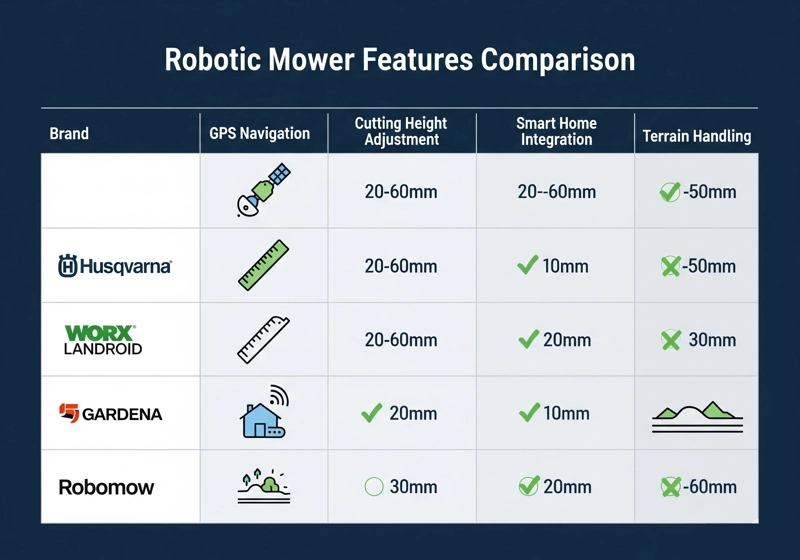
GPS vs. Boundary Wires: The Great Debate
This comes down to your property’s complexity and your patience level. GPS systems are more flexible and easier to modify if you change your landscaping. Boundary wire systems provide more precise control but require more initial setup work.
I’ve found that GPS works better for irregularly shaped properties with lots of landscape features. Boundary wire systems excel in formal, well-defined lawn areas. Both work; it’s really about matching the technology to your specific situation.
Cutting Performance That Matters
Cutting height adjustment mechanisms vary dramatically between brands. Some require manual adjustment every time you want to change height. Others let you program different heights for different zones.
Pattern variety sounds fancy in marketing materials, but random patterns work fine for most residential lawns. Systematic patterns look more professional but take longer to complete full coverage.
Smart Features vs. Smart Marketing
Alexa and Google Assistant integration is becoming standard, but the quality varies significantly. Some implementations let you do meaningful control tasks, others just let you ask for status updates.
Smartphone app quality is all over the map. The best provide detailed cutting statistics, maintenance reminders, and genuine troubleshooting help. The worst barely manage basic start/stop controls without crashing.
Installation Reality Check
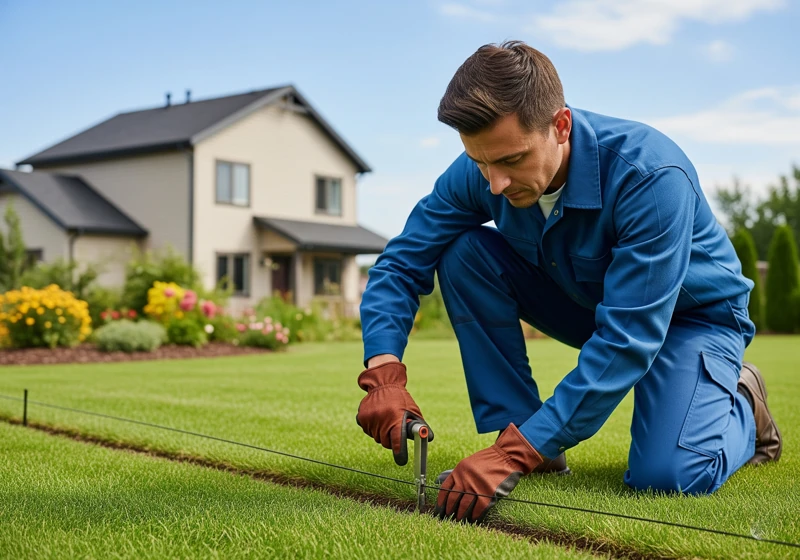
Most manufacturers offer professional installation, and honestly, I recommend it for most people. Boundary wire installation requires careful planning to avoid utility lines and ensure proper coverage. Even GPS models need initial calibration and safety zone programming.
Professional installation typically adds $300-800 but includes warranty coverage and proper setup. DIY installation is possible, but budget extra time for troubleshooting and adjustments.
Your property will need some preparation regardless of brand. Remove or secure obstacles that could damage the mower. Consider existing landscaping features that might interfere with operation.
Maintenance Reality (The Stuff Nobody Talks About)
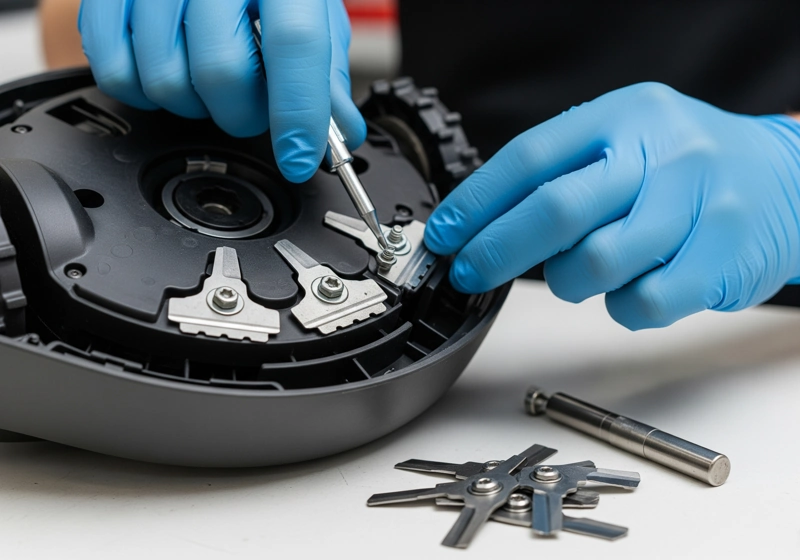
Robotic mower blades are smaller and designed for frequent replacement every 2-3 months during the active growing season. They’re inexpensive ($20-50 per set), but it’s ongoing maintenance you need to factor in.
Battery replacement is the big long-term cost. Most units need new batteries every 2-4 years, depending on usage. Replacement costs range from $100-400, which can be a nasty surprise if you’re not expecting it.
Software updates have become crucial as these machines get more sophisticated. Brands with good update systems can add features and fix bugs remotely. Others require manual updates or service visits.
Making the Decision (Without Regrets)
For properties under 0.25 acres, most entry-level models from quality brands work fine. Between 0.25 and 0.75 acres, you want mid-range models with better battery life and navigation. Larger properties require careful planning for charging station placement.
The $1,500-$2,500 range seems to be the sweet spot for most homeowners, with reliable core functionality with useful smart features. Spending less often means compromising on important features. Spending more gets you convenience features and brand prestige.
Consider the total cost of ownership, not just the purchase price. Some brands require more frequent blade changes or have higher repair costs over time.
My Honest Bottom Line
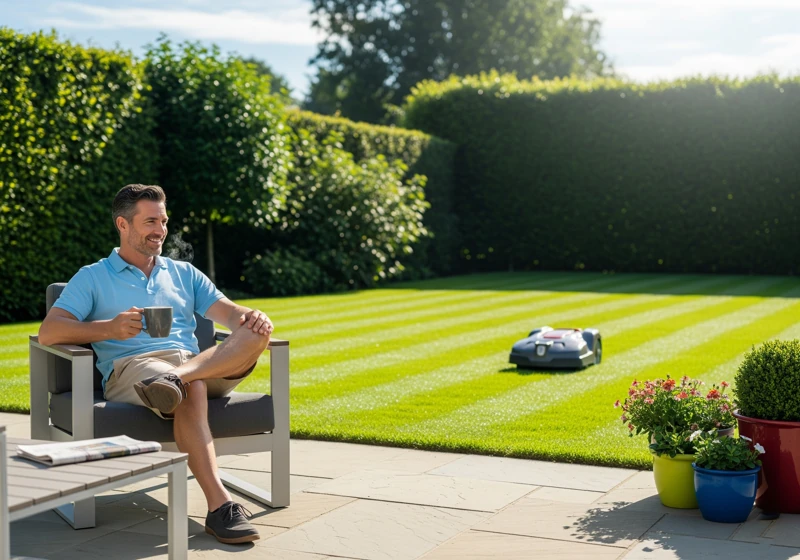
After testing these machines extensively (and finally buying one for my lawn), here’s what I think:
Husqvarna makes the best overall product, but you pay dearly for it. Worx Landroid offers the best value for most situations: good performance, smart features, reasonable price. Robomow excels in challenging terrain. Honda provides bulletproof reliability. Greenworks works for budget-conscious first-time buyers.
The right choice depends on your specific priorities and property characteristics. Don’t get seduced by every possible feature; focus on reliable cutting performance and features you’ll use.
One final piece of advice: start simple. It’s better to buy a basic model that works consistently than a feature-packed machine that spends half its time being repaired. You can always upgrade later once you understand how robotic mowing fits your lifestyle.
Trust me, once you experience Saturday mornings without mowing, you’ll wonder why you waited so long.
Based on extensive testing and user reviews, the Husqvarna Automower 450X consistently ranks as the highest-rated robotic lawn mower. It offers superior GPS navigation, handles up to 1.25 acres, tackles 45-degree slopes, and provides exceptional build quality. However, the “best” depends on your specific needs. Worx Landroid offers better value for money, while Robomow excels on challenging terrain.
The main disadvantages include high upfront costs ($800-$4,500), ongoing maintenance like blade replacement every 2-3 months, potential theft risk, and limitations with obstacles or extremely uneven terrain. They also require boundary wire installation or GPS setup, may struggle with very long grass, and can be affected by weather conditions. Additionally, some models leave border areas that still need manual trimming.
Quality robotic lawn mowers typically last 5-10 years with proper maintenance. Premium brands like Husqvarna and Honda often reach the upper end of this range, while budget models may need replacement after 3-5 years. The main factors affecting lifespan are build quality, usage intensity, maintenance frequency, and environmental conditions. Battery replacement every 2-4 years is usually the most significant maintenance cost.
GPS systems offer more flexibility, easier setup changes, and work better for irregularly shaped properties. Wire-based systems provide more precise boundary control and are generally more reliable, but require more complex installation. For most homeowners, GPS is more convenient, but wire systems excel in formal landscapes with clearly defined cutting areas. Your property’s complexity should guide this decision.
For most homeowners with properties of 0.25-1 acre, robotic mowers are worth the investment. They save 2-3 hours weekly, improve lawn quality through frequent micro-cutting, and eliminate the physical effort of traditional mowing. The time savings alone often justify the cost within 2-3 years. However, properties under 0.25 acres may not see enough benefit to justify the expense and setup complexity.
Professional installation typically costs $300-$800 in addition to the mower price, depending on the property’s complexity and local labor rates. DIY installation is possible but requires 4-8 hours for boundary wire setup and calibration. GPS models are generally easier to install on your own. Total first-year costs, including the mower, installation, and initial accessories typically range from $1,200-$5,000 depending on the brand and property size.
