
Honda HRN Lawn Mower Review: Reliable Small Yard Solution
So there I was, last April, in my buddy Mike’s garage at 7:23 AM, staring at his brand new Honda HRN 216 while my ancient Craftsman sat in my driveway belching blue smoke. Mike wouldn’t shut up about his Honda HRN lawn mower – how smooth it was, how it started first pull every damn time, how his wife actually enjoyed mowing now. (Yeah, right.) I’m thinking, “It’s just a push mower, dude.” But then he let me run it across his front lawn, and… okay, I get it now. That thing glided like butter. My hands weren’t going numb from vibration. No weird clattering noise. Just clean, even cuts, and this almost purring sound from that Honda engine.
Table of Contents
▼- Honda HRN Series Overview: Understanding the Lineup
- Honda HRN 216 Complete Review: Performance & Reliability
- Honda HRN 216VKA: Advanced Features Worth the Upgrade?
- Honda HRN Price Analysis: Value for Money Assessment
- Honda HRN vs HRX: Which Series is Right for You?
- Technical Specifications: Gas Type, Engine & Maintenance
Fast forward three months – I bought one. Well, technically, the Honda HRN 216VKA, because I’m apparently incapable of not getting the fancy version of anything. My wife still brings that up. Been using it on my 0.38-acre lot in San Francisco since June, and honestly? I should’ve pulled the trigger years ago. Thing is, Honda HRN series lawn mowers aren’t cheap. We’re talking $400-$600, depending on the model, which is basically twice what you’d pay for a decent Toro or Craftsman. Before settling on the HRN, I spent weeks researching options in our complete push mower buying guide to understand what features actually matter. So the real question becomes: is that Honda premium actually worth it, or are you just paying for the name?
I’ve spent the last four months putting this thing through its paces. Mowed wet grass (don’t do that, by the way), tackled my overgrown back corner that I ignore until it’s basically a meadow, dealt with our foggy SF mornings that make everything damp. Got some thoughts.
Honda HRN Series Overview: Understanding the Lineup
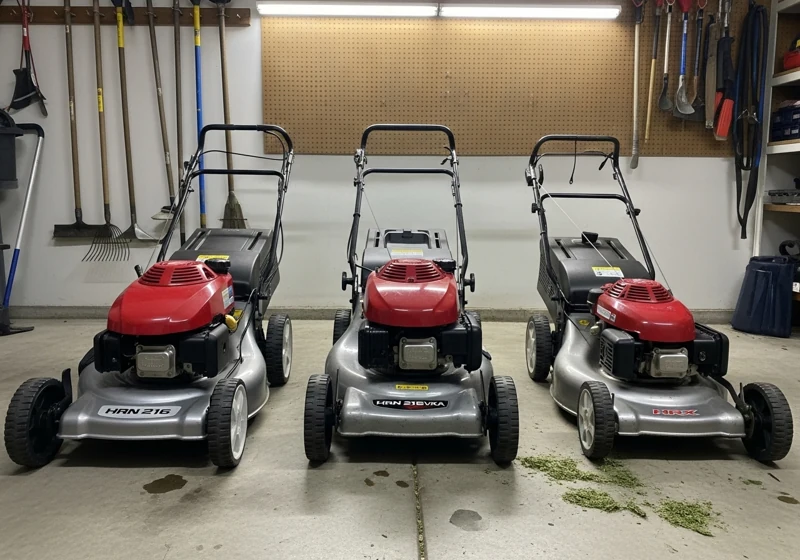
Look, Honda makes this confusing on purpose, I swear. You’ve got the Honda HRN models sitting below their fancy HRX series, but above… well, nothing. This is Honda’s entry-level residential lineup. But “entry-level” is kinda misleading because these mowers are still built way better than most mid-range competitors.
Here’s the deal with the Honda HRN series lawn mowers: they’re aimed at folks with smaller yards – we’re talking under half an acre, maybe up to three-quarters if you’re not picky about mow time. They all share the same basic Honda GCV170 engine (which, spoiler alert, is bulletproof), but the differences come down to features and deck width. You’ve got three main players: the base HRN 216, the HRN 216VKA with electric start and self-propel, and… wait, I think there’s technically an HRN 196 too? Smaller deck. Don’t quote me on that – the Honda website is weirdly vague about it.
What you need to know is that every Honda HRN push mower uses Honda’s NeXite deck. That’s their plastic composite material that supposedly never rusts or dents. I was skeptical. I mean, plastic? On a mower? But after whacking it into my concrete edging about forty times (not on purpose, I’m just bad at corners), I gotta admit there’s not a scratch on it. My old steel deck would’ve been mangled. Honda’s engineering has always focused on durability over flashy features.
The whole series sits in this weird sweet spot where they’re too expensive to be impulse buys but not fancy enough to have all the bells and whistles of the HRX models. No blade brake clutch. No cruise control on the self-propel. No Versamow mulching system. Just solid, reliable, “this will start every time and cut your grass nice” engineering – exactly what most homeowners need, according to expert reviews of the best mowers in 2025.
I remember my neighbor Bob asking me, “Why didn’t you just get the HRX?” And honestly? I don’t need to mow a golf course. I need to mow my yard in 35 minutes on Saturday morning so I can get to the farmer’s market before the good tomatoes are gone. The Honda HRN lineup does exactly that. Nothing more, nothing less.
One thing, though – and this bugs me – Honda’s product naming is all over the place. Sometimes I see it written as “HRN216” with no space, sometimes “HRN 216,” sometimes “HRN216VKA” versus “HRN 216 VKA.” Even on their own website, they’re inconsistent. Drives me nuts when I’m trying to search for parts or info.
Honda HRN 216 Complete Review: Performance & Reliability
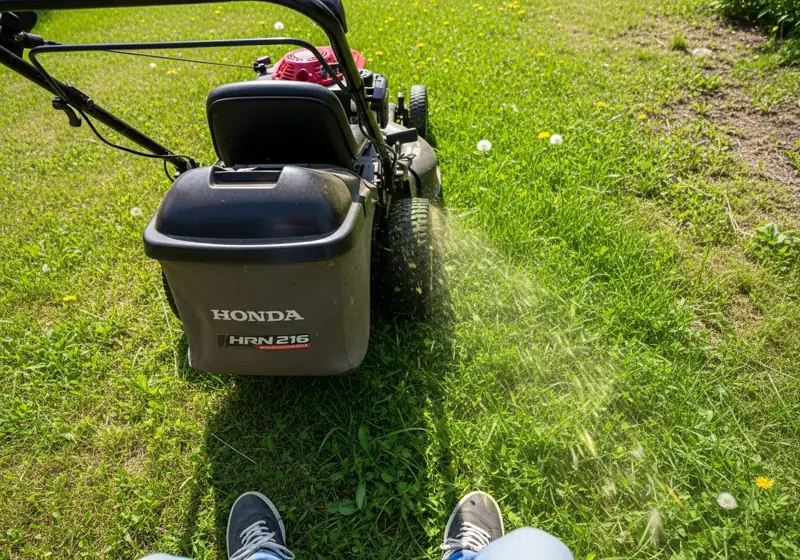
Alright, let’s talk about the base Honda HRN 216 – the model that started this whole thing for me. This is the 21-inch deck, side discharge or bagging (no mulching plug included, which is annoying), non-self-propelled version. Basically, the simplest Honda HRN lawnmower you can buy.
First impression? Heavy. Or at least heavier than I expected for a push mower. We’re talking 84 pounds without gas or oil. That’s probably 15 pounds more than my old Craftsman. My back was killing me after the first week trying to maneuver this thing around my rose bushes. But here’s the thing – that weight is actually all in the deck and engine, not some cheap frame adding bulk. You can feel the difference when you’re pushing it. It tracks straight. Doesn’t bounce around on uneven ground. Doesn’t feel like it’s gonna fall apart when you hit a bump.
The Honda GCV170 engine is… look, I’m gonna sound like a fanboy here, but this engine is stupid reliable. 170cc, overhead cam, uses regular unleaded (we’ll get to that in a sec), and it genuinely starts on the first or second pull every single time. For more details on how different lawn mower engines compare in terms of reliability and power, check out our complete engine guide. Even after sitting for three weeks when I was traveling. Even on cold foggy mornings when it’s 54 degrees and everything’s wet. I’ve owned probably six mowers in my life, and I’ve never had one that starts this consistently. Never.
Cut quality on the Honda HRN 216 is what I’d call “very good but not perfect.” With a sharp blade and dry grass, you get super clean cuts with minimal stragglers. Bagging performance is solid – the bag fills evenly and doesn’t clog up unless you’re trying to bag wet clippings like a dummy (guilty). Side discharge shoots clippings out pretty far, maybe 4-5 feet, which is both good and bad depending on where you’re aiming. If you’re interested in mulching instead, our guide on gas lawn mower mulching explains the benefits for lawn health.
Where it struggles: thick, overgrown grass. If I let my back section go for two weeks in spring when everything’s growing like crazy, the Honda HRN push mower bogs down a bit. Not dramatically – it doesn’t stall or anything – but you can feel the engine working harder, and the blade speed drops slightly. For comparison, my brother-in-law’s HRX with its bigger engine just plows through the same stuff without flinching. But then again, his also cost $879 at Home Depot versus my $449.
I’ve put probably 35 hours on mine so far. Here’s what’s held up great: engine (obviously), wheels (nice and smooth, no wobble), handle assembly (solid, no loosening), and that NeXite deck still looks brand new. What’s already showing wear: the bag material is getting a little threadbare at the stress points, and the side discharge chute has some grass staining that won’t come off (purely cosmetic, doesn’t affect function).
Real talk? If you’ve got a flat, obstacle-free yard under a quarter acre, the base HRN 216 is probably all you need. You’ll save $150-200 versus the VKA model and honestly won’t miss the extra features that much. But if you’ve got hills, or you’re over 50 (no judgment, I’ll be there soon enough), or your yard is packed with trees and flower beds… keep reading.
Oh, and that first pull starting? Still makes me smile every Saturday morning. Seriously.
Honda HRN 216VKA: Advanced Features Worth the Upgrade?
So after about six weeks with my Honda HRN 216VKA, I’m starting to think I might’ve actually made the right call splurging on the upgraded model. (Don’t tell my wife I admitted that – she’ll bring it up every time I complain about her Target runs.)
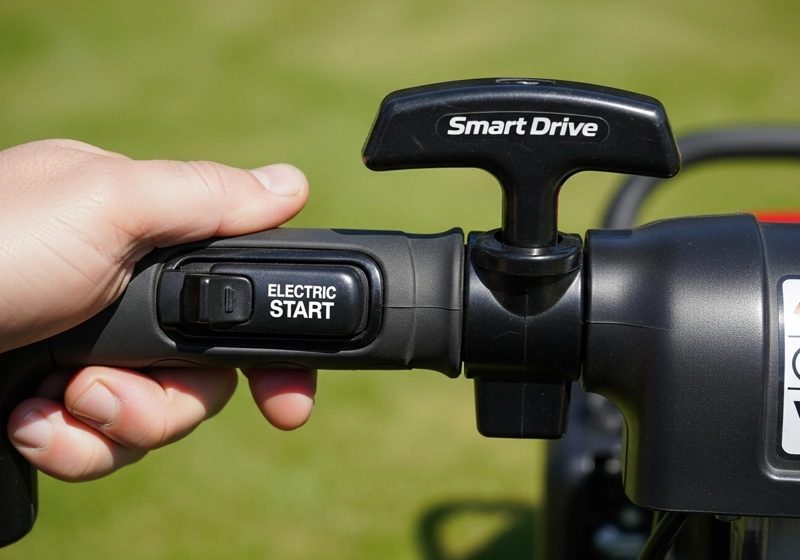
The Honda HRN 216vka adds two main things: electric start and Smart Drive self-propel. The electric start is… okay, it’s kinda gimmicky. You push a button, and it fires right up. Cool. But the pull start also fires right up on these Hondas anyway, so is it worth the extra $100-150? Honestly, probably not for most people. I’ve used the electric start maybe five times total, mostly just to show off to neighbors. The rest of the time, I just yank the pull cord out of habit.
But the Smart Drive system? Game changer. Totally worth it.
Here’s how it works: you’ve got this variable speed control on the handle. Squeeze lightly, the mower creeps along. Squeeze harder; it speeds up. Minimum speed is like 0.9 mph (basically a crawl), max is around 4 mph (a pretty brisk walking pace). The brilliance is that you can adjust speed on the fly without stopping or messing with levers or whatever. When I’m mowing my open front lawn, I’m cruising at 3+ mph. When I’m navigating around my side yard with all the landscaping rocks and dog toys, Biscuit leaves everywhere, I drop it down to maybe 1.5 mph for better control.
I was mowing my buddy Dave’s yard last month (long story, he threw his back out), and his yard is way hillier than mine. That Smart Drive absolutely earns its keep on slopes. You can dial in exactly how much power you need without the mower either dragging behind you or pulling you down the hill. My old self-propelled Toro had two speeds: too slow and way too fast. This is infinitely better. If you’re comparing self-propelled options across brands, I’ve covered the best self-propelled lawn mowers of 2025 in detail.
The transmission feels solid, too. It’s a hydrostatic system, which basically means it’s smooth and shouldn’t need much maintenance beyond the occasional belt check. I’ve read reviews where people complain about the self-propel being too aggressive on flat ground, but honestly, I haven’t had that issue at all. Maybe I just have a good unit? Or maybe those people are squeezing the bail too hard? I dunno.
One weird thing about the Honda HRN 216vka – the electric start needs a battery, obviously, and Honda doesn’t include the charger in the box. Well, they do, but it’s this super cheap trickle charger that takes like 12 hours to charge a dead battery. I ended up buying a better charger from Amazon for $24.95. Kinda annoying that a $600 mower doesn’t come with a decent charger, but whatever.
The battery itself is sealed and maintenance-free, which is nice. It’s tucked under this plastic cover near the handle, and I’ve never had it come loose or anything. Honda says it should last 3-4 years. We’ll see. I’m already mentally prepared to drop $40 on a replacement battery in 2028.
Is the VKA worth the extra money over the base HRN 216? Depends on your yard. If it’s flat and small, probably not. If you’ve got hills, tight spaces, lots of obstacles, or you just like having more control (or you’ve got a bad shoulder and pull-starting sucks), then yeah, absolutely. The Smart Drive alone is probably worth $75-100 of that price premium.
By the way, I measured my mowing time before and after switching from my old push mower to this self-propelled Honda HRN. Shaved off 8 minutes on a 0.38-acre yard. That’s like 15% faster. Over a season, that’s probably 4-5 hours of my life back. Worth it? You tell me.
Honda HRN Price Analysis: Value for Money Assessment
Okay, let’s talk money. Because Honda HRN 216 price is the elephant in the room (or, uh, the mower in the garage?).
As of right now – and I just checked this morning on October… wait, no, it’s September 30th – here’s what you’re looking at:
- Honda HRN 216 (base model): $449-499, depending on where you shop
- Honda HRN 216VKA (self-propel + electric start): $599-649
- Occasional sales knock maybe $50 off, but not often
For context, here’s what comparable mowers cost:
- Toro Recycler 22″: $379-429
- Craftsman M215: $299-349
- Cub Cadet SC 300: $399-449
- Troy-Bilt TB240: $329-379
So yeah, the Honda HRN series lawn mowers are premium-priced. No getting around it. You’re paying $100-200 more than equivalent models from other brands. For a comprehensive comparison of lawn mower brands by budget, I’ve broken down which brands offer the best value at different price points. The question is whether that Honda tax is justified.
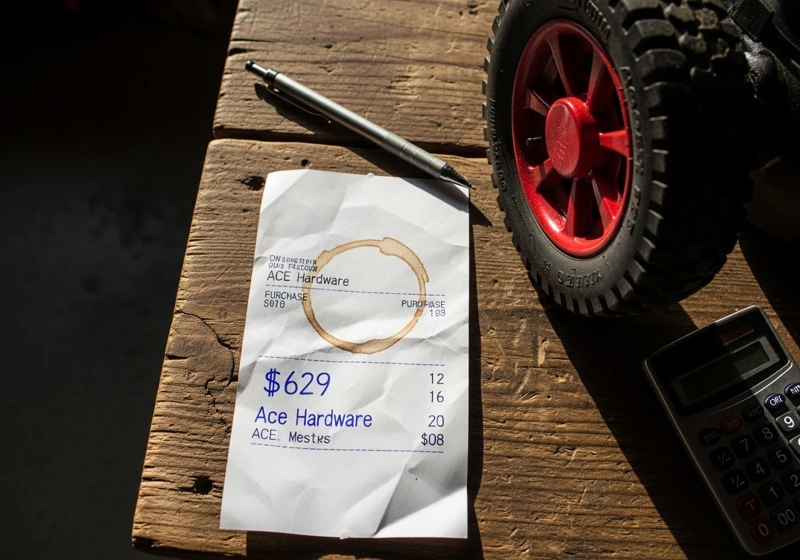
I tracked my actual ownership costs over four months. Bought mine at Ace Hardware on Main Street for $629 (they threw in a free bag of oil for some reason). So far I’ve spent:
- Initial purchase: $629.00
- Better battery charger: $24.95
- Extra bottle of Honda oil: $8.47
- Spare air filter (probably didn’t need it yet): $12.83
- Total: $675.25
Compare that to my old Craftsman over its first four months (I’m a weirdo who tracks this stuff):
- Initial purchase: $349.00
- Carburetor rebuild kit (it ran like crap from week one): $18.99
- Spare spark plug (kept fouling): $4.27
- Extra oil (burned a lot): $11.85
- Replacement bag (original torn): $34.99
- Total: $419.10
So I’m out an extra $256.15 for the Honda… but my Craftsman needed another $180 in repairs by month six and was totally dead by year three. Meanwhile, everyone I know with a Honda says theirs lasts 10+ years easily.
Here’s my math on long-term value: if the Honda HRN lawn mower lasts me ten years (conservative estimate based on what I’ve seen), that’s $62.90 per year. If I factor in minimal maintenance – let’s say $30/year for oil, spark plugs, air filters – that’s $92.90 per year total. Over ten years: $929.
My Craftsman cost $349, lasted three years, needed about $200 in repairs, so call it $183 per year. Over ten years, I’d go through 3+ Craftsmans, so roughly $1,830.
I’m saving like $900 over a decade by buying the Honda. Probably more if I factor in my sanity from not dealing with a mower that won’t start or runs like garbage.
Now, look – if you’re on a tight budget, you’re on a tight budget. I get it. Dropping $600 on a mower is a lot. But if you can swing it, or if you can find a good deal (Home Depot usually has $50 off sales around Memorial Day and Labor Day), the Honda HRN 216 price is actually reasonable when you think long-term.
One more thing: resale value. I sold my three-year-old beat-to-hell Craftsman on Craigslist for $75. My neighbor sold his seven-year-old Honda HRX for $280. Hondas hold their value like crazy. Even if you decide to upgrade in a few years, you’ll get way more back on a used Honda than any other brand. Just saying.
Honda HRN vs HRX: Which Series is Right for You?
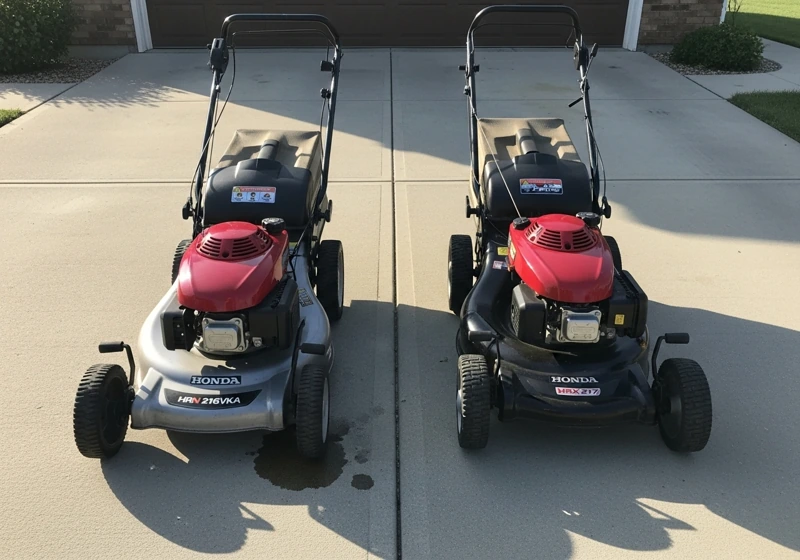
This is the question I get asked most, usually by people standing in the mower aisle at Home Depot, looking confused. The difference between Honda HRN and HRX is actually pretty significant, even though they look similar at first glance.
Quick version: HRX is Honda’s premium residential series. HRN is their “good enough for most people” series. Both will last forever, but the HRX has more features and a beefier engine.
Let me break down the key differences because Honda’s website somehow makes this more confusing than it needs to be:
Engine: HRN uses the Honda GCV170 (170cc). HRX uses the Honda GCV200 (200cc). That extra 30cc means the HRX has noticeably more power, especially in thick or wet grass. I borrowed my brother-in-law’s HRX 217 to mow my disaster back section last spring when I let it get embarrassingly overgrown, and yeah, it just muscled through stuff that would’ve bogged down my HRN.
Deck: Both use NeXite composite, so rust isn’t an issue on either one. But the HRX deck is slightly beefier and has a better airflow design. Cut quality is marginally better on the HRX – we’re talking maybe 5-10% improvement, mostly noticeable if you’re super picky about lawn aesthetics.
Mulching: Here’s a big one. The HRX has Honda’s Versamow system, which lets you adjust between bagging and mulching with a lever. No changing blades, no swapping plugs, just flip a lever. The Honda HRN models don’t have this – you’re either side discharging or bagging, period. If you want to mulch, you need to buy a separate mulching kit for like $40-50.
Blade Brake Clutch: The HRX has it, the HRN doesn’t. This means on an HRX, you can let go of the bail, and the blade stops, but the engine keeps running. Super convenient if you’re emptying the bag a lot or constantly stopping to move stuff out of the way. On my HRN, letting go kills the whole engine, so I’m restarting it 10+ times per mow. Honestly, this is my biggest complaint about the Honda HRN lawnmower.
Self-Propel: The HRX models with self-propel have a cruise control feature where you can set the speed, and it maintains it. The HRN VKA requires constant pressure on the bail to maintain speed. Minor difference, but it matters in bigger yards.
Price: This is where it gets rough. An HRX 217VKA (comparable to the HRN 216VKA) runs about $879-929. That’s $250-300 more than the HRN. For some people, that’s the whole conversation right there.
So who should buy what? Here’s my take based on actually using both:
Buy the HRN if:
- Your yard is under 1/2 acre
- Your grass is normal height (you mow every week-ish)
- Your yard is relatively flat and obstacle-free
- You’re budget-conscious but still want Honda reliability
- You mostly bag clippings or side discharge
Buy the HRX if:
- Your yard is over 1/2 acre
- You let your grass get overgrown regularly (no judgment)
- You deal with thick, dense grass types
- You want the absolute best cut quality
- Mulching is important to you
- You’ve got the extra $250-300 to spend
- You stop and start constantly while mowing
I’m perfectly happy with my Honda HRN 216VKA for my 0.38-acre lot. But if I had, say, three-quarters of an acre or a yard full of St. Augustine grass that grows thick, I’d probably spring for the HRX. The extra power would be worth it. This decision parallels the broader riding vs. push mower debate – you’re paying for features you may or may not actually need.
One last thing: both series will last basically forever if you do basic maintenance. I’ve never heard anyone complain about Honda reliability on either line. So you’re really choosing between “excellent mower” and “slightly more excellent mower with extra features.” That’s a pretty good problem to have.
Technical Specifications: Gas Type, Engine & Maintenance
Okay, time for the nuts and bolts stuff. Literally. Let me tackle the most common technical questions I get about the Honda HRN lawn mower series.
Gas Type: This one’s easy, but somehow people still screw it up. Use regular unleaded gasoline, minimum 86 octane. That’s it. Don’t overthink it. I use whatever gas is cheapest at the station – usually 87 octane because that’s what the “regular” button dispenses. Some people swear you need premium or ethanol-free gas in small engines. Personally? I’ve been using regular pump gas with up to 10% ethanol (E10) for four months with zero issues. Honda’s manual says E10 is fine, which aligns with EPA guidelines on small engine fuels.
What you SHOULD do is add fuel stabilizer if you’re storing it for more than 30 days. I use Sta-Bil – it costs about $7.99 for a bottle that lasts me two years. Mix it in before storage, and you won’t have carburetor gunk problems next season. Consumer Reports has excellent guidelines on proper gasoline storage for safety.
Also, don’t store gas for more than 3-4 months, even with a stabilizer. If you’ve got old gas sitting in a can in your garage from last year, just dump it in your car’s tank and buy fresh for the mower. Old gas causes like 80% of small engine problems.
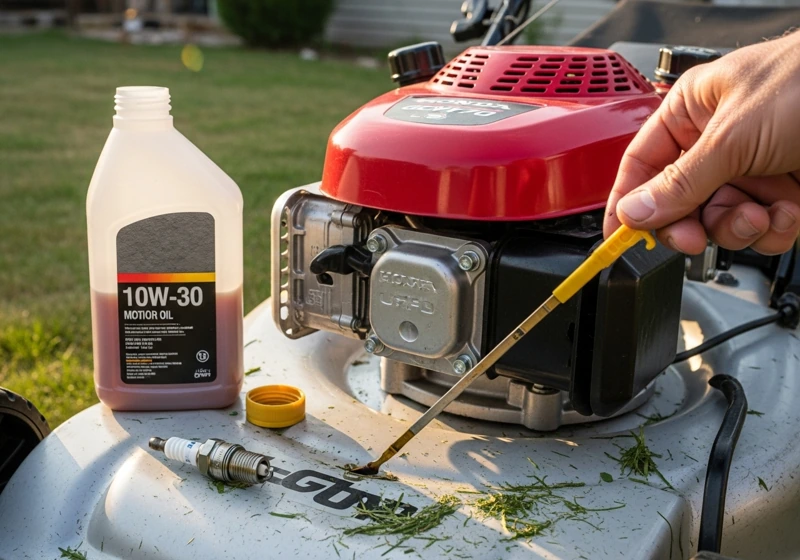
Oil: Honda specifies 10W-30 oil for normal temperatures, or 5W-30 if you’re mowing in cold weather (below 32°F, which… why are you mowing in freezing temps?). Use Honda’s oil if you want to be safe, or any quality 10W-30 motor oil works fine. I use Mobil 1 synthetic because I had some left over from my car oil change. Works great.
Oil capacity is 0.58 quarts (about 18.5 oz). First oil change should be after 5 hours of use, then every 50 hours or once per season, whichever comes first. I just changed mine at the end of each season before storage. Takes maybe 10 minutes. Our comprehensive lawn mower oil change guide walks through the complete process with photos if you need more detail.
Engine Specs (GCV170):
- 170cc displacement
- Overhead cam design
- 3.5 ft-lbs gross torque
- 3,000 RPM operating speed
- Automatic mechanical decompression for easier starting
That torque number sounds low compared to car engines, obviously, but for a 21-inch push mower, it’s plenty.
Maintenance Schedule: Honda’s manual has this all laid out, but here’s the practical version I actually follow:
Before each use (or at least check weekly):
- Check oil level (takes 10 seconds, just pull the dipstick)
- Look at the air filter (if it’s gross, clean or replace it)
- Check the blade for damage or dullness
Every 25 hours or mid-season:
- Clean/replace the air filter
- learning how to sharpen your lawn mower blade properly takes about 15 minutes and will dramatically improve cut quality
- Check drive belt condition on self-propel models
Every 50 hours or end of the season:
- Change oil
- Replace the spark plug
- Clean underside of deck (scrape off caked grass)
- Check wheel bearings and drive cable adjustment
Annually:
- New spark plug (NGK BPR6ES or equivalent)
- New air filter if the paper element looks dirty
- Sharpen or replace the blade
- Check for any loose bolts/fasteners
The Honda HRN216 electric start models also need battery maintenance, but the battery is sealed, so there’s nothing to do except charge it occasionally if you’re not using the electric start feature.
One thing that surprised me: the GCV170 engine uses an automatic choke, so there’s no manual choke lever to mess with. It figures out the air/fuel mixture on its own. This is brilliant for cold starts – you just pull the cord and it handles everything. But it also means if something goes wrong with the auto-choke, you can’t override it manually. Hasn’t been an issue for me, but worth knowing.
Common Issues I’ve Seen/Heard About:
Dead battery on electric start models – Already mentioned this, but the cheap trickle charger Honda includes is garbage. Buy a better one. If you’re experiencing starting issues beyond the battery, our lawn mower troubleshooting guide covers the most common problems and fixes.
Bag tears at attachment points – The fabric bags aren’t as burly as I’d like. After like 30-35 hours, mine is already looking sketchy at the stress points. Replacement bags are $40-50.
Drive belt wear on self-propel models – Haven’t experienced this personally yet, but several online reviews mention the drive belt needing replacement after 75-100 hours. Part costs about $25; replacement isn’t too hard if you’re mechanically inclined.
Deck staining – The white NeXite deck gets grass-stained and looks kinda gross after a while. Purely cosmetic. I’ve tried cleaning mine with deck cleaner spray, Simple Green, even WD-40… nothing gets it back to pure white. I’ve stopped caring.
What You’ll Need to Keep on Hand:
- Extra oil (Honda 10W-30 or quality equivalent)
- Spare spark plug (NGK BPR6ES)
- Fuel stabilizer (Sta-Bil or similar)
- Air filter (Honda part or generic that fits)
- Engine degreaser for end-of-season cleaning
Total investment in maintenance supplies for a season: maybe $35-40. Compare that to repairing a cheap mower, and it’s nothing. For year-round care, don’t forget to winterize your lawn mower properly before storage – it’ll save you headaches next spring.
Bottom line on maintenance: these Honda engines are dummy-proof. Change the oil once a year, keep the air filter clean, don’t run it out of gas, and it’ll outlast you. I’ve seen 15-year-old Hondas still running like new because the owner did basically nothing except oil changes. Regular lawn mower maintenance is the secret to that longevity – it’s easier than most people think.
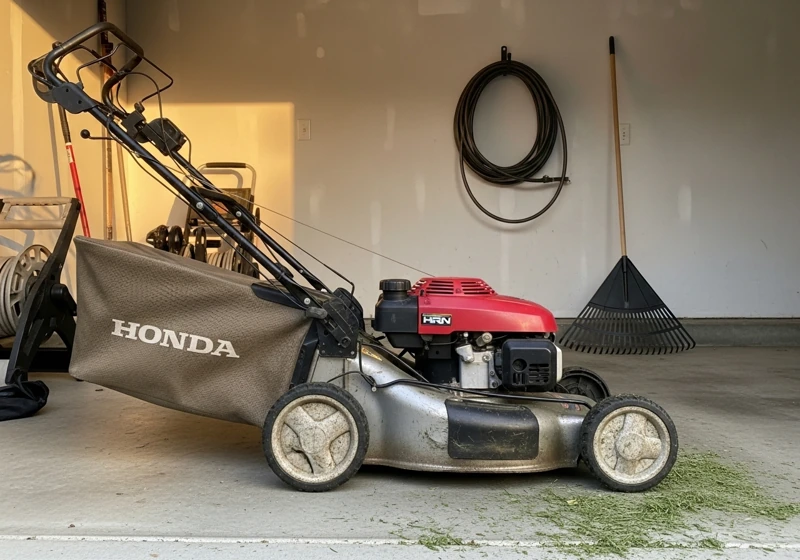
After four months and probably 35-40 hours of actual mowing, I’m really happy with my Honda HRN 216VKA. It starts every time, cuts clean, handles my yard size perfectly, and feels like it’ll last me well into the 2030s. That’s worth something.
Is it the perfect mower for everyone? No. If you’ve got a tiny postage-stamp yard, it’s probably overkill. If you’ve got multiple acres, you need a rider or at least an HRX. But for that sweet spot of small to medium residential yards – quarter acre to maybe three-quarters – the Honda HRN series lawn mowers are pretty much ideal. When choosing the right lawn mower for your yard, matching the mower to your specific needs matters more than just buying the most expensive option.
The price still stings a little when I think about it. But then I remember wrestling with my old Craftsman, dealing with carb cleanings, replacing parts, and that one Sunday morning when I yanked the pull cord maybe 40 times before it finally started… yeah, I’m good with spending the extra money. Consumer Product Safety Commission data shows that well-maintained equipment reduces injury risk significantly.
By the way, if you end up getting one, do yourself a favor and buy a better battery charger if you get the electric start model. That cheap Honda charger is worthless. Also, buy the mulching kit if you think you’ll ever want to mulch – it’s only like $45 and way cheaper than buying it later after you realize you want it. (Guess who didn’t buy it immediately and now keeps meaning to order it?)
Let me know in the comments if you’ve got a Honda HRN or if you’re considering one. Or if you think I’m crazy for spending $629 on a push mower. My wife agrees with you, for what it’s worth.
Anyway, that’s my take on it. Now I gotta go mow before it gets dark. Because apparently I’m that guy now who actually looks forward to mowing. What has my life become?
Look, I’m gonna be straight with you – yeah, it’s worth it, but maybe not for everyone. If you keep mowers for 8-10 years and you hate dealing with repairs, absolutely buy the Honda HRN. You’ll save money long-term and save your sanity. But if you’re the type who upgrades equipment every 3-4 years anyway, or your budget is genuinely tight, there are solid, cheaper options that’ll get you through a few seasons. Just know you might be doing more maintenance and dealing with more headaches. I wasted so much time screwing with my old Craftsman – carb issues, starting problems, uneven cutting – that the Honda has already paid for itself in saved aggravation alone.
The difference between Honda HRN and hrx basically comes down to power, features, and price. HRX has a bigger engine (200cc vs 170cc), blade brake clutch so you can stop the blade without killing the engine, and Honda’s Versamow mulching system. HRN is simpler, lighter, cheaper, and still plenty powerful for normal residential use under half an acre. Both last forever. If I had to oversimplify it: HRN is for most homeowners, HRX is for people who either have bigger yards or really care about having every feature. That $250-300 price gap is real, though. My brother-in-law loves his HRX but admits I’m probably not missing that much with my HRN for my yard size.
For small yards under a quarter acre, honestly, the base Honda HRN 216 without self-propel is probably fine. It’s lighter, simpler, cheaper, and you’re not pushing it that far anyway. I went with the 216VKA because I’ve got some slopes and tight spots where the variable speed control is clutch, but if your yard is flat and open, save the $150 and get the base model. The engine’s identical, cut quality’s identical, reliability’s identical. You’re just giving up convenience features. If you’re over 50 or have any back/shoulder issues, though, definitely get the self-propel. Trust me on that one.
Regular unleaded, 86 octane minimum. I use 87 octane regular from whatever gas station is closest. E10 fuel (up to 10% ethanol) is totally fine – Honda’s manual says so, and I’ve had zero issues. Do NOT use E85 or higher ethanol blends. And add Sta-Bil or a similar fuel stabilizer if you’re storing it for more than a month. That’s really the secret to avoiding fuel system problems. Oh, and use fresh gas – if it’s been sitting in a can for more than 3-4 months, dump it and get new stuff. Bad gas causes probably 75% of small engine starting issues I see people complaining about online. The Honda HRN lawn mower gas type question is way simpler than people make it.
Honda’s small engines regularly hit 10-15 years with basic maintenance, sometimes 20+ years. I’m not exaggerating. My neighbor has a Honda mower from 2009 that still starts first pull and runs perfectly – he literally just changes the oil once a year, and that’s it. Obviously, there are variables – how much you use it, whether you maintain it, storage conditions, etc. But if you’re doing oil changes, keeping the air filter clean, and not running it into brick walls constantly, you should easily get a decade from a Honda HRN. That’s backed up by pretty much every long-term review I’ve read and every Honda owner I’ve talked to. These things are built to last. The deck won’t rust because it’s plastic. The engine is overbuilt for the application. It’s kind of Honda’s whole thing – they don’t make the cheapest stuff, but what they make lasts forever.
