
Types of Lawn Mowers: A Comprehensive Guide
Standing in the lawn mower aisle at any home improvement store can feel overwhelming, rows upon rows of machines with different sizes, power sources, and features that all claim to be perfect for your yard. Last month, a customer named Sarah walked into our garden center looking completely defeated. “Mike,” she said, “I’ve been researching mowers for three weeks, and I’m more confused now than when I started. There are so many types of lawn mowers, I don’t even know where to begin.
Table of Contents
▼- Understanding Your Mowing Needs First
- Yard Size Categories
- Terrain Considerations
- Personal Factors
- Push Mowers: The Foundation of Lawn Care
- Manual Reel Mowers
- Gas-Powered Push Mowers
- Electric Push Mowers (Corded)
- Battery-Powered Push Mowers
- Self-Propelled Mowers: Adding Convenience
- Front-Wheel Drive Models
- Rear-Wheel Drive Models
- All-Wheel Drive Systems
- Riding Mowers: Comfort and Efficiency
- Lawn Tractors
- Garden Tractors
- Zero-Turn Mowers
- Specialty Mower Types
- Robotic Mowers
- Hover Mowers
- Commercial Walk-Behind Mowers
- Making the Final Choice: Finding the Best Lawn Mower for You
- Choosing the Right Type for Your Needs
- Small Yards (Under 8,000 sq ft)
- Medium Yards (8,000-20,000 sq ft)
- Large Yards (Over 20,000 sq ft)
- Maintenance Considerations by Type
- Low-Maintenance Options
- Traditional Maintenance Requirements
- Making Your Final Decision
- Prioritize Your Must-Haves
- Consider Long-Term Satisfaction
- Test When Possible
I completely understand that frustration. In my 15 years in the lawn mower industry, I’ve watched the market expand from a handful of basic options to dozens of specialized machines designed for every conceivable yard situation. The good news? Once you understand the different categories and what each type does best, choosing becomes much simpler.
Whether you’re a first-time homeowner trying to figure out basic yard maintenance or an experienced gardener looking to upgrade your equipment, this guide will walk you through every major type of lawn mower and help you find the best lawn mower available today. I’ll share what I’ve learned from testing hundreds of models and helping thousands of customers find their perfect match.
Understanding Your Mowing Needs First
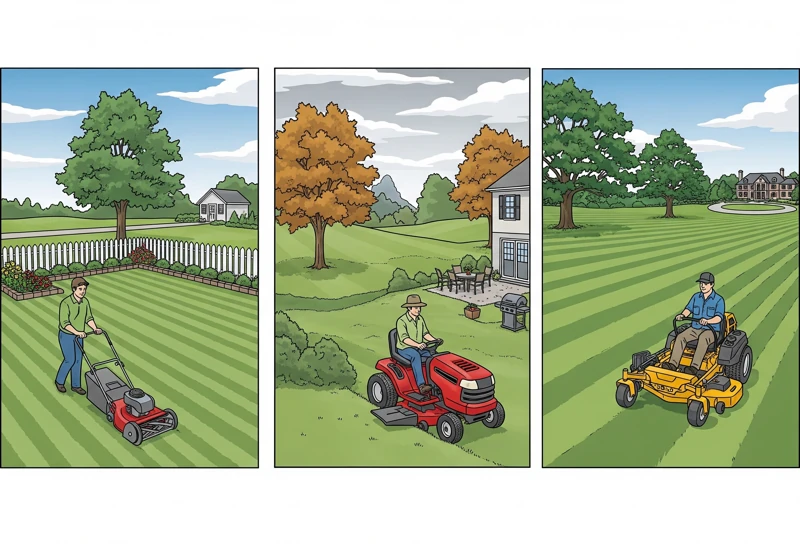
Before we dive into specific mower types, let me share something I’ve learned from years of helping customers: the best mower isn’t necessarily the most expensive or most powerful one; it’s the one that matches your specific yard conditions and personal preferences.
Yard Size Categories
Here’s how I break down properties when helping customers choose the right type of mower. Small yards (under 10,000 square feet) have different needs than large properties, and understanding these differences guides everything else.
Small yards typically benefit from lightweight, maneuverable mowers that store easily and start quickly. Large properties need powerful, efficient machines that can cover ground without wearing you out. Medium yards often work best with versatile options that balance power and convenience.
Terrain Considerations
Flat, simple yards open up all mower types, while slopes, obstacles, and rough terrain eliminate certain options. I’ve seen customers struggle with the wrong mower type simply because they didn’t consider their specific terrain challenges during the selection process.
Personal Factors
Your physical capabilities, available storage space, maintenance comfort level, and noise considerations all influence which types of lawn mowers make sense for your situation. There’s no shame in choosing convenience over raw power. The best mower is the one you’ll use regularly.
Push Mowers: The Foundation of Lawn Care
Let’s start with the most basic category that forms the foundation of residential lawn care. Push mowers require you to provide the forward motion while the engine or motor powers the cutting blades.
Manual Reel Mowers
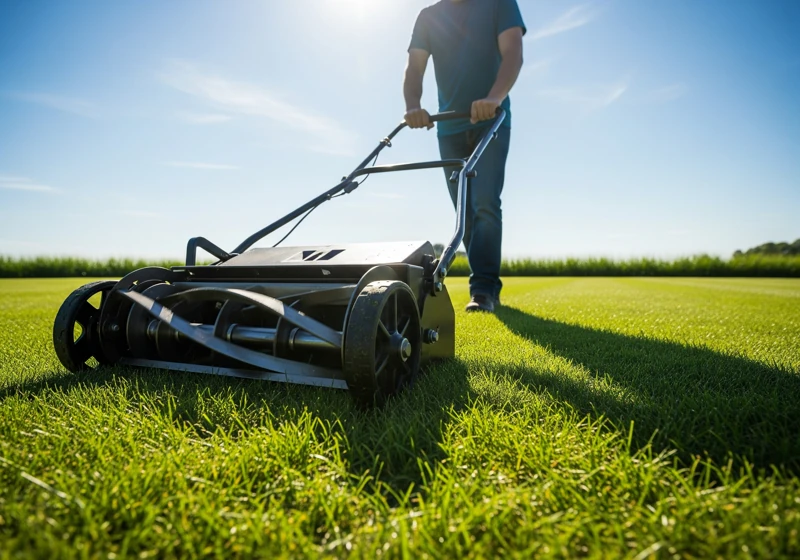
These are the classic cylinder mowers that your grandfather might have used, no engine, just sharp blades that spin as you push. I know they seem old-fashioned, but hear me out on why they’re experiencing a comeback.
Manual reel mowers provide the finest cut quality of any mower type. The scissor-like cutting action slices grass cleanly rather than tearing it, which promotes healthier grass growth and reduces brown tip damage. They’re also completely silent, require minimal maintenance, and provide excellent exercise.
Here’s what I tell customers considering reel mowers: they work beautifully on small, flat yards with fine grass types like bentgrass or Bermuda. However, they struggle with thick grass, weeds, and uneven terrain. You’ll also need to mow more frequently since they can’t handle overgrown grass effectively.
Expect to spend $100-300 for a quality manual reel mower. The Fiskars StaySharp and American Lawn Mower Company models get consistent positive feedback from my customers.
Gas-Powered Push Mowers
These represent the traditional workhorses of suburban lawn care. Gas push mowers combine reliable power with affordability, making them the most common type I see in residential garages.
Modern gas push mowers typically feature 140-190cc engines that provide consistent power for yards up to about 12,000 square feet. The cutting decks range from 20-22 inches, striking a good balance between efficiency and maneuverability.
What I love about gas push mowers is their independence, no cords to manage, no batteries to charge, just fill with gas and go. They handle thick grass, wet conditions, and challenging terrain better than most other types. Maintenance is straightforward if you’re comfortable with basic small engine care.
The downsides? They’re noisy, produce emissions, require seasonal maintenance, and can be challenging to start, especially after sitting unused. Prices range from $200-500 for quality models from Honda, Toro, and Craftsman.
Electric Push Mowers (Corded)
Corded electric push mowers offer an interesting middle ground between manual and gas power. They provide consistent, reliable power without the maintenance headaches of gas engines.
I’ve tested numerous corded models, and they deliver impressive cutting performance for small to medium yards. The power is immediate and consistent, no pull cords, no warm-up time, just plug in and start cutting. They’re also significantly quieter than gas mowers and produce zero direct emissions.
The cord limitation is obvious but manageable on smaller, simpler yards. I’ve watched customers develop efficient mowing patterns that work around the cord restriction without much inconvenience.
Quality corded electric mowers range from $150-400. The BLACK+DECKER MM2000 and Greenworks corded models consistently earn positive customer feedback for reliability and cutting performance.
Battery-Powered Push Mowers
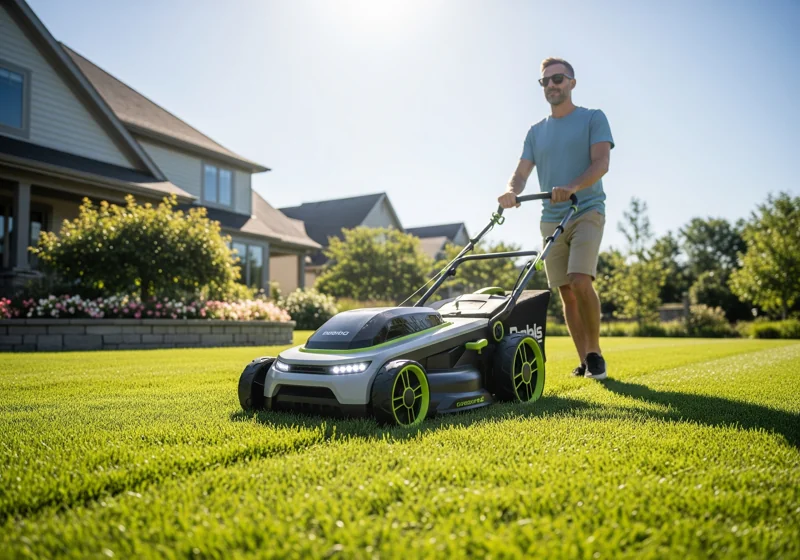
This category has exploded in popularity over the past five years, and for good reason. Battery technology has improved dramatically while prices have become more reasonable.
Modern lithium-ion battery mowers provide 30-60 minutes of runtime, easily covering most residential yards. The power delivery is smooth and consistent, and the convenience factor is remarkable: no cords, no gas, no pull cords, just press a button and go.
I’ve been particularly impressed with 40V and higher voltage systems from EGO, Greenworks, and Ryobi. These provide power comparable to gas mowers while eliminating all the traditional hassles of engine maintenance.
Battery mowers work best for regular maintenance cutting on yards up to about 8,000 square feet. They can struggle with overgrown or very thick grass, and runtime becomes a consideration on larger properties.
Expect to invest $300-600 for quality battery push mowers, with replacement batteries adding $100-200 every 3-5 years.
Self-Propelled Mowers: Adding Convenience
Self-propelled mowers include drive systems that move the mower forward, reducing the physical effort required for larger yards or challenging terrain.
Front-Wheel Drive Models
Front-wheel drive mowers pull themselves forward using powered front wheels while you control steering and speed. They work well on flat terrain and provide good maneuverability around obstacles.
The main limitation I’ve observed is reduced traction when the grass bag fills up, shifting weight to the rear wheels. They can also struggle on slopes or uneven terrain where rear wheel traction becomes important.
Front-wheel drive models typically cost $50-100 less than comparable rear-wheel drive versions, making them attractive for budget-conscious buyers with suitable terrain.
Rear-Wheel Drive Models
Rear-wheel drive systems push the mower forward using powered rear wheels. This configuration provides better traction, especially on slopes, and maintains consistent drive performance even with full grass bags.
I recommend rear-wheel drive for most customers choosing self-propelled mowers. The improved traction and hill-climbing ability make them more versatile, and the price difference is usually modest.
Most major manufacturers offer rear-wheel drive versions of their popular models, with prices ranging from $400-800, depending on features and build quality.
All-Wheel Drive Systems
Some premium manufacturers offer all-wheel drive mowers that power all four wheels for maximum traction. These excel on challenging terrain, steep slopes, and properties with difficult conditions.
Honda’s Smart Drive system and Toro’s Personal Pace are examples of advanced drive systems that automatically adjust to your walking speed and provide superior traction. They’re more expensive but worthwhile for demanding applications.
Riding Mowers: Comfort and Efficiency
When the yard size exceeds what you want to handle with a walk-behind mower, riding mowers become attractive options. They transform mowing from physical exercise into a more comfortable, efficient process.
Lawn Tractors
Traditional lawn tractors feature front-mounted engines and gear-driven transmissions. They’re designed primarily for mowing with some light utility capability.
Lawn tractors work well for properties from 1-3 acres, offering 42-54 inch cutting decks that cover ground efficiently. The turning radius is wider than zero-turn mowers, but they’re more affordable and simpler to maintain.
I typically recommend lawn tractors for homeowners who want comfortable mowing without the complexity of zero-turn systems. They’re also better for customers who need some towing capability for yard carts or light attachments.
Quality lawn tractors range from $1,200-3,000, with popular models from Craftsman, Cub Cadet, and John Deere leading the market.
Garden Tractors
Garden tractors are heavy-duty versions of lawn tractors, built for more demanding applications and extensive attachment use. They feature larger engines, stronger frames, and more robust transmissions.
These machines excel on larger properties with varied terrain and heavy attachment use. If you need to pull a cart, run a snow blower, or operate a tiller, garden tractors provide the power and durability required.
The investment is significant $2,000-5,000 for quality models, but they’re built to last decades with proper maintenance. Customers who choose garden tractors typically own 2+ acres and use multiple attachments throughout the year.
Zero-Turn Mowers
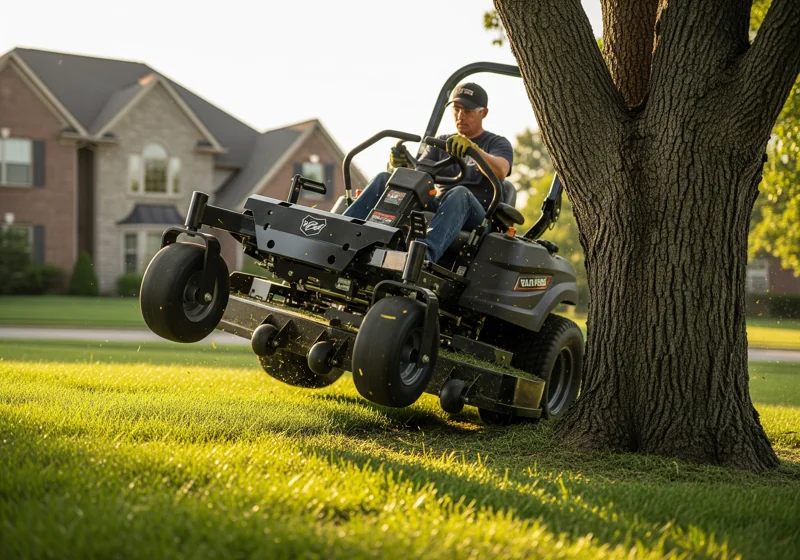
Zero-turn mowers represent the pinnacle of mowing efficiency, using independent wheel motors or hydrostatic drives to achieve zero-radius turns. This maneuverability dramatically reduces mowing time on properties with obstacles.
I’ve timed zero-turn mowers cutting the same yard 30-40% faster than traditional riding mowers, simply due to their superior maneuverability around trees, flower beds, and other obstacles.
The learning curve is real; zero-turn controls take practice to master smoothly. However, most customers adapt within a few mowing sessions and never want to go back to traditional steering systems.
Zero-turn mowers start around $2,500 for residential models and can exceed $10,000 for commercial-grade machines. Popular residential brands include Ariens, Bad Boy, and Hustler.
Specialty Mower Types
Beyond the main categories, several specialty mower types serve specific needs or niche applications.
Robotic Mowers
Robotic mowers represent the cutting edge of lawn care automation. These battery-powered units navigate your yard independently, cutting grass continuously to maintain a consistent height.
I’ve been watching robotic mower development closely, and the technology has improved dramatically. Modern units like the Husqvarna Automower and Worx Landroid handle complex yards with multiple zones and obstacles.
The installation requires perimeter wire setup, and the initial investment is substantial $1,000-4,000, depending on yard size and features. However, customers who leap often become enthusiastic advocates for the hands-off convenience.
Robotic mowers work best on relatively flat yards without excessive obstacles. They excel at maintaining grass height through frequent, small cuts rather than traditional weekly mowing.
Hover Mowers
Hover mowers use air cushions to float above the ground, making them ideal for slopes, banks, and irregular terrain where wheeled mowers struggle.
These specialized machines excel in applications where traditional mowers can’t operate safely or effectively. I’ve seen them used successfully on steep embankments, around ponds, and on rough terrain.
The cutting quality isn’t as refined as traditional mowers, and they require more skill to operate effectively. They’re specialty tools rather than general-purpose mowers.
Commercial Walk-Behind Mowers
Commercial walk-behind mowers bridge the gap between residential push mowers and riding equipment. They feature larger engines, wider cutting decks, and commercial-grade construction.
These mowers typically offer 32-48 inch cutting decks with hydrostatic transmissions for variable speed control. They’re designed for efficiency on larger properties while maintaining the maneuverability of walk-behind operation.
Homeowners with 1-2 acre properties sometimes choose commercial walk-behinds for their durability and efficiency, though the investment is substantial at $2,000-5,000.
Making the Final Choice: Finding the Best Lawn Mower for You
After all this information, you’ve reached the final step. I’ve spent years helping customers in my garden center, and I can tell you that the right lawn mower isn’t about the biggest engine or the highest price tag. It’s about finding the right partner for your yard.
It’s about matching your unique needs to a machine that makes your life easier. Think of it like this: The best lawn mower for a small suburban yard is rarely a giant, zero-turn tractor. That’s a tool for a different job. The real goal is to find the machine that you’ll enjoy using, a mower that feels like a natural extension of your hands and helps you maintain a pristine yard without a struggle.
So, take a moment to reflect on what you’ve learned. The best riding lawn mower for a large property isn’t the same as the best walk-behind mower for a small one. Consider your terrain, your storage space, and your comfort level. A quality push mower might be the best residential lawn mower for someone with a small, flat yard, while a zero-turn might be the perfect fit for a property with many obstacles.
The information in this guide is your roadmap. Use it to weigh your options, compare different types, and be honest with yourself about your needs. When you find the right mower, the weekly chore of cutting the grass will transform into a satisfying and even enjoyable part of homeownership.
Choosing the Right Type for Your Needs
After helping thousands of customers navigate mower selection, here’s the decision framework I use to match people with the best lawn mower for their needs.
Small Yards (Under 8,000 sq ft)
For small yards, convenience and storage typically matter more than raw power or speed. Battery-powered push mowers offer the best combination of performance and convenience for most situations.
Consider manual reel mowers if you have fine grass, enjoy exercise, and prioritize environmental impact. Gas push mowers make sense if you prefer proven technology and don’t mind maintenance requirements.
Medium Yards (8,000-20,000 sq ft)
Medium yards benefit from self-propelled mowers to reduce physical effort while maintaining good maneuverability. Rear-wheel drive models provide the best versatility for varied terrain.
Battery technology is reaching the point where it can handle medium yards effectively, especially with higher voltage systems. Gas self-propelled mowers remain popular for their proven reliability and unlimited runtime.
Large Yards (Over 20,000 sq ft)
Large yards typically justify riding mowers for comfort and efficiency. Lawn tractors work well for straightforward mowing, while zero-turn mowers excel on properties with many obstacles.
The specific choice depends on terrain, obstacles, and personal preferences. Some customers prefer the exercise and precision of commercial walk-behind mowers even on larger properties.
Maintenance Considerations by Type
Different mower types have vastly different maintenance requirements, and this should factor into your decision process.
Low-Maintenance Options
Manual reel mowers require only occasional blade sharpening and basic cleaning. Battery-powered mowers need battery care and blade maintenance, but eliminate engine service.
Electric corded mowers are similarly low-maintenance, requiring mainly blade care and basic cleaning. These options appeal to customers who want to minimize ongoing maintenance involvement.
Traditional Maintenance Requirements
Gas-powered mowers require seasonal tune-ups, including oil changes, air filter replacement, spark plug service, and fuel system maintenance. The frequency depends on usage, but budget $50-100 annually for basic service.
Riding mowers add complexity with additional systems to maintain transmissions, drive belts, and more complex engine systems. However, they typically receive better care since the investment is larger.
Making Your Final Decision
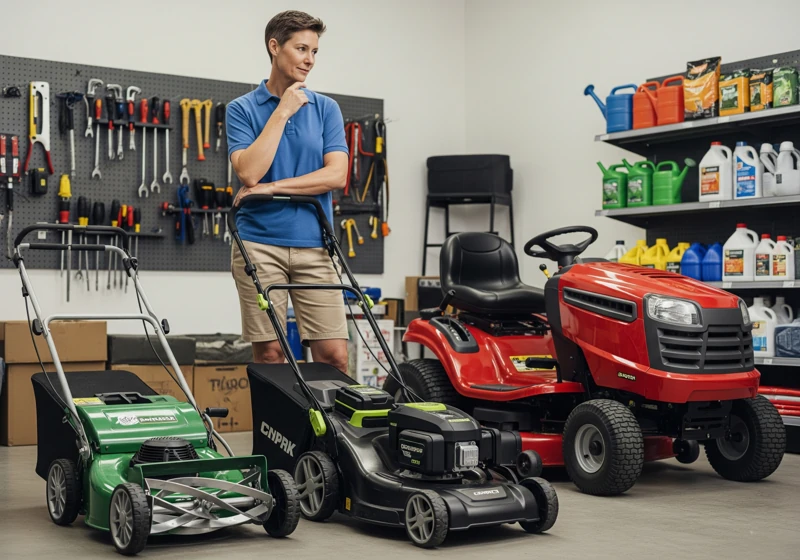
The best type of lawn mower for your situation depends on balancing your specific needs, preferences, and constraints. Here’s what I’ve learned matters most in real-world satisfaction.
Prioritize Your Must-Haves
Start with non-negotiable requirements, yard size, capacity, storage limitations, noise restrictions, or maintenance preferences. These factors eliminate inappropriate options quickly.
Consider Long-Term Satisfaction
Think beyond initial purchase price to long-term ownership experience. A slightly more expensive mower that you enjoy using will provide better value than a cheaper option that makes mowing a chore.
Test When Possible
Many dealers offer demonstration opportunities or return policies. Take advantage of these when possible. Nothing beats experience for understanding how different mower types feel in operation.
The lawn mower market offers more choices than ever before, which creates both opportunities and confusion. By understanding the strengths and limitations of each type, you can make an informed decision that serves you well for years to come.
The lawn mower market offers more choices than ever before, which creates both opportunities and confusion. By understanding the strengths and limitations of each type, you can make an informed decision that serves you well for years to come. Remember, there’s no universal “best” mower, only the best lawn mower for your specific situation.
The article identifies several main types: push mowers (manual, gas, corded electric, and battery-powered), self-propelled mowers (which reduce physical effort), and riding mowers (including lawn tractors, garden tractors, and zero-turns for large yards). There are also specialty types like robotic and hover mowers for specific needs.
To choose the right mower, you should first assess your yard size, the terrain (flat vs. sloped), and your personal preferences (maintenance comfort, noise tolerance, and storage space). The best mower isn’t the most expensive one, but the one that best fits your specific situation.
Both have pros and cons. Petrol (gas) mowers offer more power and unlimited runtime, making them good for thick grass or large properties. They are noisy and require more maintenance. Battery mowers are quieter, low-maintenance, and convenient to start. They work best for smaller to medium yards and may struggle with overgrown grass due to limited power and runtime.
A self-propelled mower is better if you have a larger yard or challenging terrain, as it significantly reduces physical effort. The drive system pushes the mower forward, providing better traction on slopes. A push mower is better for smaller, flat yards where maneuverability and lower cost are more important than reduced effort.
For a bumpy or uneven lawn, you should consider a mower with good traction and maneuverability. Rear-wheel drive self-propelled mowers are a solid choice because the powered rear wheels provide better traction on uneven ground. For very challenging or steep terrain, a hover mower might be the ideal specialty tool, as it floats above the ground and is not limited by wheels.
